Cultural foods, or traditional dishes, are a delicious representation of the traditions, beliefs, and practices of different regions, ethnic groups, and religions around the world. These dishes often reflect a community’s culture and can include unique ways of preparing and using specific ingredients. Passed down through generations, cultural foods are central to our identities and family connections. They also play a big role in religious celebrations and bring people together. Take Asian traditional dishes like sushi, dumplings, and curry, for example; they highlight the rich flavors and diverse customs that show just how important food is to culture.
In the U.S., people often follow the USDA guidelines to eat healthily, which recommend eating a variety of fruits and veggies. While they do mention some cultural foods like bok choy, taro leaves, mung beans, and lotus root, there’s still a lot of room to explore the diverse selection of healthy foods from different cultures. Food is a big part of culture, and it plays an important role in all communities. By incorporating traditional cultural foods into our diets, we not only enjoy a wider range of flavors but also gain the health benefits that come with eating a variety of nutritious foods. Eating this way can help keep everyone healthy and connected to their cultural roots.
Incorporating a variety of cultural foods into our diets not only adds exciting flavors but also provides a wealth of health benefits. While Western health websites often spotlight foods like kale and quinoa, traditional foods such as Gailan, water spinach, rice, and soybeans offer similar nutritional value. Embracing these diverse, nutritious options highlights the importance of food in cultural identity and community well-being. By expanding our healthy eating guidelines to include more traditional cultural foods, we can promote better health for everyone and celebrate the rich culinary heritage that different cultures bring to the table.
Born to a glass painter and a poet, Teo Nguyen is a remarkable Vietnamese-American artist living in Minnesota. Teo is creating breathtaking new art that captures the beauty of real-life scenes, nature, solitude, struggle, and identity. His work showcases a deep connection to both his heritage and his surroundings, revealing layers of meaning and emotion in each piece.
Teo Nguyen’s artistry is a testament to his unique perspective as both an immigrant and an artist. He says, “As an immigrant and an artist, I have learned to embrace the American spirit of freedom that says if you see a road that interests you, go ahead: venture down it. Even so, I am always a stranger to what I see; always slightly outside, finding in what is ordinary to others something tender and strange.”
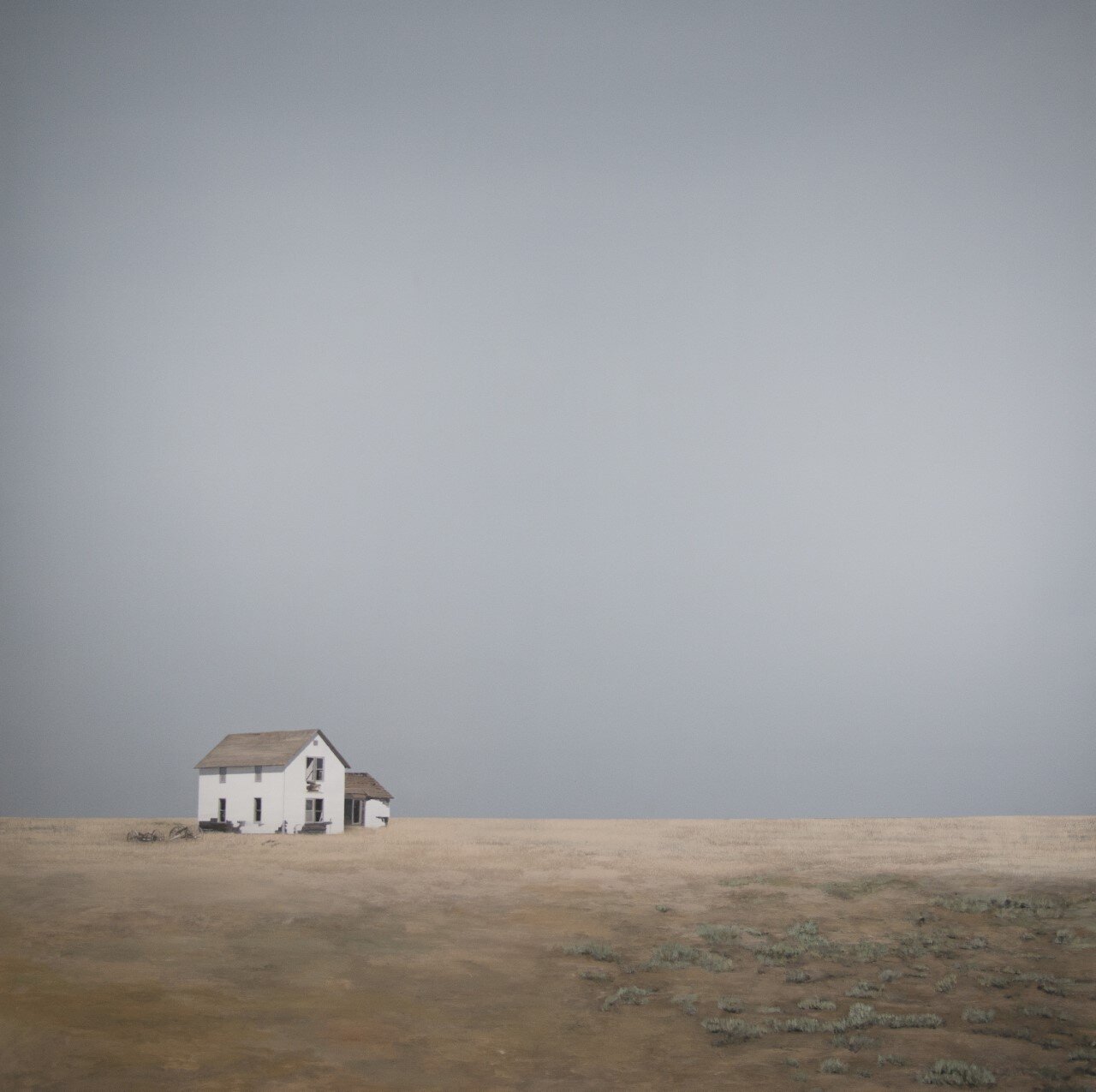
Nguyen finds much of his inspiration by immersing himself in nature. He begins his creative process by sketching outdoors, capturing the essence of his creations before transforming them into larger-scale works in his studio. His photorealistic pieces are so meticulously crafted that, at first glance, they could be mistaken for photographs. The balance of light and space in Nguyen’s work is masterful, creating stunning scenes that leave viewers in awe.
Teo Nguyen’s art not only reflects the physical beauty of the world but also invites us to see the extraordinary in the ordinary. Through his eyes, familiar landscapes become tender and strange, offering a new perspective on identity and existence.
Kid $wami, an Asian American rap artist, has risen to prominence as a contemporary hip hop sensation in St. Paul, Minnesota. Known for his unique blend of cultural influences and innovative beats, he has carved out a distinct niche in the music scene. Kid $wami’s journey from local talent to celebrated artist has been marked by his ability to connect deeply with a diverse and devoted fan base. His groundbreaking music, characterized by insightful lyrics and dynamic rhythms, is not only breaking new ground but also challenging the norms of the hip hop genre. With each release, Kid $wami continues to redefine what it means to be an Asian American artist in the ever-evolving landscape of contemporary hip hop.
Photo: Kid $wami
Kid $wami uses his music platform to address crucial issues that resonate deeply with him, drawing from his personal experiences to craft songs that touch on themes such as social justice, mental health, and self-expression. His lyrics reflect his journey and the struggles he has faced, making his music a powerful tool for advocacy and change. By candidly discussing these topics, Kid $wami not only highlights important societal challenges but also empowers his listeners to speak out and share their own stories. His message has become a beacon for those seeking to have their voices heard, fostering a community of resilience and solidarity through the transformative power of music.
Kid $wami stands as a beacon of authenticity and courage in the world of contemporary hip hop, using his music to champion social justice, mental health awareness, and the importance of self-expression. Through his deeply personal and impactful lyrics, he not only connects with his audience on a profound level but also inspires countless others to find their own voice and stand up for what they believe in. As he continues to break new ground and resonate with listeners across diverse backgrounds, Kid $wami’s artistry remains a testament to the transformative power of music and the enduring strength of the human spirit.
Ricky Sim never envisioned a career in standup comedy during his youth due to his fear of performing onstage. “I was really scared to be onstage,” he recalled. Like many first- and second-generation immigrants, Sim’s concern over financial stability led him to practice law for five years. Today, however, the Queens-based writer and standup comedian uses his platform to challenge norms and address the underrepresentation of queer Asian comedians.
Photo: Andrew Max Levy
Despite starting his career in the industry around 12 years ago, Sim chose to take a hiatus due to the lack of Asian representation in comedy, which often resulted in blatant racism disguised as humor. Reflecting on that period, he recalls that most open mic nights were predominantly attended by white men, who would mockingly greet him with lines like, “Oh, look. The delivery guy is here,” whenever they saw an Asian participant.
Sim faced additional challenges due to his sexuality in a predominantly homophobic environment. Despite this, his desire to share his story, particularly about his mother and the gay Chinese-Malaysian experience, helped him overcome the scarcity mindset and embrace the uncertainties of a challenging career. “This is what my heart is telling me to do,” Sim remarked, deciding to follow his passion. In 2023, he performed at the Edinburgh Festival Fringe, where he presented his one-man show, “Coming Out To Dead People.” The show’s success continued at London’s Off-West End Soho Theatre and recently debuted Off-Broadway at Soho Playhouse, before returning to the Edinburgh Festival Fringe as an EdFringe OffFest Finalist.
“The United States has forgotten about the Hmong people and what they did. We helped the Americans. We died for the Americans–and we still are, long after the war has ended. And isn’t it ironic that most Americans don’t even know who we are.”
-General Vang Pao, 1979
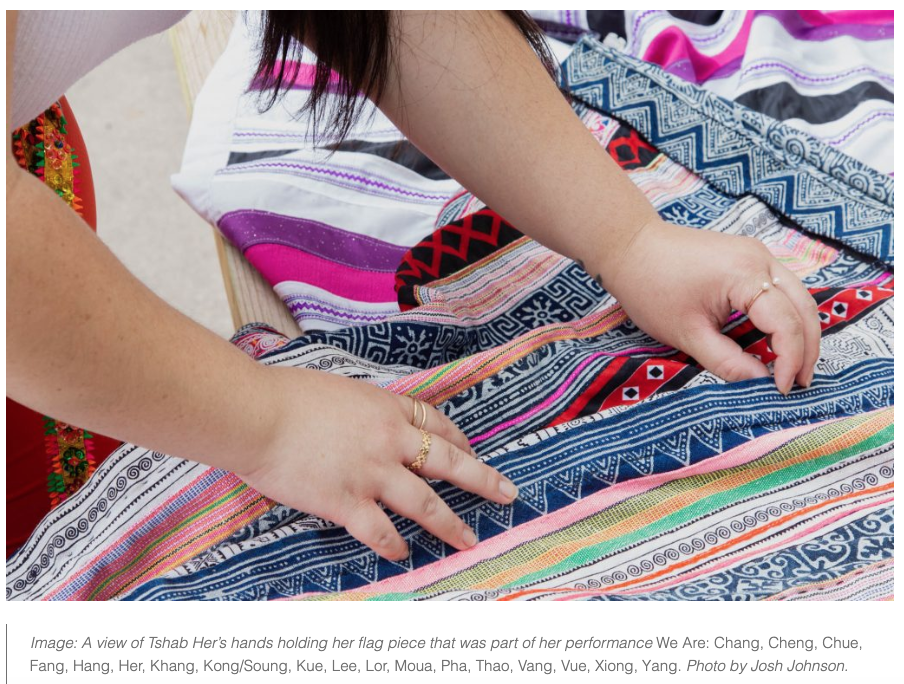
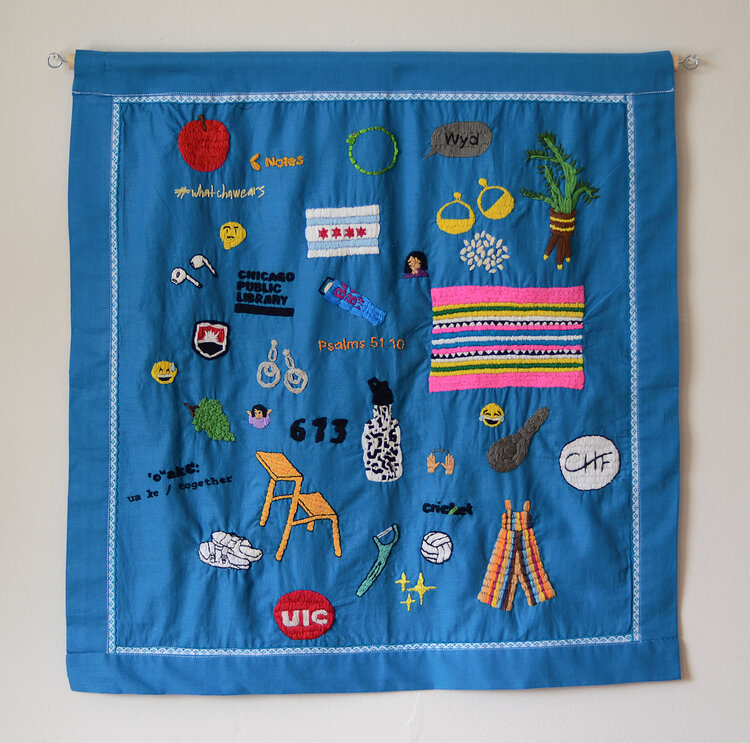
Through her lived experience as a second-generation Hmong-American woman, her artistic endeavors both illuminate and complicate the intricate politics of displacement. As a member of a nation-less ethnic minority originating from Southeast Asia, she grapples with the looming threat of cultural erasure. Her creative output serves as a testament to the dispersed nature of the Hmong community, probing the significance of location and the spaces in between. Employing a diverse array of mediums including embroidery, installation art, and social engagement, she navigates the realms of political and cultural discourse.
In her artistic practice, she harnesses the power of color as a communicative tool, sparking conversations about spatial dynamics, ownership, and the assertion of identity. By integrating traditional Hmong textiles, language, and strategic placement of materials, she delves into the nuanced question of belonging, whether it pertains to physical land or the autonomy of the body. Her work becomes an integral part of the ongoing dialogue surrounding the historical trajectory of political refugeeism in the United States.
Photo: Tshab Her
Art serves as her chosen platform to explore the intricate interplay between visibility and invisibility within the context of the Hmong diaspora. Through her creative process, she not only situates her own body but also those of others within this complex narrative landscape, seeking to uncover the generative spaces that exist within the margins of societal consciousness.
Food insecurity, a pervasive global issue, affects individuals and families across all economic strata, stemming from insufficient resources or restricted access to safe, nutritious food. Its ramifications extend beyond hunger, manifesting in compromised physical and mental well-being, diminished academic performance in children, and increased prevalence of chronic illnesses like diabetes and heart disease. Often synonymous with “food poverty,” it diverges from food shortages, which denote insufficient food supplies in a given area. Rather, food insecurity arises from economic challenges such as poverty or unemployment, rendering existing food resources inaccessible to certain demographics.
Food insecurity has a deeply rooted history in the United States, stretching back to colonial times when farmers grappled with erratic harvests. The Great Depression of the 1930s amplified this issue as widespread job losses left many without means to feed themselves. President Lyndon Johnson’s declaration of a “war on poverty” in the 1960s highlighted the nation’s growing concern over food insecurity, which has since remained intertwined with poverty. Presently, over 40 million Americans, roughly one in eight households, face food insecurity, impacting diverse demographics such as children, the elderly, low-wage earners, rural residents, and racial minorities. Moreover, women bear a disproportionate burden of this challenge.
Signs of Food Insecurity
Signs of food insecurity encompass skipping meals, reducing portion sizes, facing trade-offs between food and essential expenses like rent, and turning to food assistance programs for support.
Below, Verywell Mind has compiled a list of the most common signs of food insecurity:
Shifting meal patterns—skipping meals, eating smaller meals, or relying on less expensive items like macaroni and cheese instead of healthier foods
Inability to store food—food may spoil quickly due to lack of refrigeration or other storage solutions.
Low energy levels—lack of nutritious foods can lead to fatigue, headaches, and other health issues.
Worrying about running out of food—constant concern about having enough food for the family.
Physical changes—weight loss or gain due to insufficient access to healthy diets.
Tips for Reducing Food Insecurity
Verywell Mind has also listed suggestions for individuals and communities seeking to alleviate food insecurity:
Support food banks and other organizations that provide meals or groceries to those in need.
Encourage local businesses to donate unsold items to food banks or other organizations.
Advocate for public policies that prioritize access to nutritious foods in areas where food deserts exist.
Volunteer at soup kitchens, shelters, or other local organizations providing meals for the hungry in your community.
Educate yourself and others about the signs of food insecurity and how to identify it in your own life or that of another person.
Start a community garden to provide fresh fruits and vegetables to those in need.
Donate money or other items (e.g., canned goods, non-perishable foods) to organizations providing meals for the hungry in your community.
Create a support system of family members, friends, neighbors, and co-workers who can help provide resources or meals when needed.
Provide emotional support and understanding to those going through food insecurity—listen without judgment or offering unsolicited advice.
Encourage public discussion about food insecurity—raise awareness by starting conversations with friends and family about the issue.
Food insecurity poses a significant global challenge, impacting millions and causing profound physical, mental, and social hardships. Engaging in actions like donating, volunteering, advocating for policy reform, and establishing support networks can significantly alleviate this issue for affected individuals and families. If you or someone you know is experiencing food insecurity, seeking assistance from organizations such as Feeding America can offer valuable support and resources.
Rooted in compassion for all life, non-violence, and mindfulness, Buddhist cuisine is one of the hallmarks of vegetarian cooking. As Buddhist practice traveled across Asia and to the West, the doctrines influenced the diet of the Buddhist community, creating a colorful and harmonious culinary culture. In some Buddhist communities there are quite strict dietary regulations that must be observed, such as not eating any strong or pungent vegetable or seasoning. This means that onions, garlic, leeks, chives, shallots, and ginger, would not be used. In other sects these flavors are acceptable so as long as they are used sparingly, or to just add enough flavor, nothing to excite the taste buds too much. Regardless of what is used, so as long as it is prepared mindfully and for the benefit of sustaining life it is acceptable.
Many Buddhists in the Theravada tradition eat meat, however some also observe a vegetarian diet as well. One surprising fact is that the Buddha was not actually a vegetarian, he did eat meat only if it were offered to him. In China, tofu became a major source of protein for the Buddhist communities practicing the Mahayana tradition. Tofu is packed with nutrients, protein, and iron, it’s also flavorful and very filling too!. When mashed it can be used in mock meat dishes, when sliced it can be fried, hence the reason it’s such a popular choice food among vegetarians across the world. Some studies have shown that tofu can even reduce the risk of cancer and heart disease.
Vietnamese Buddhist cuisine is light and refreshing, and also uses lots of tofu. In vietnam many kinds of mock meats are made by using dried tofu skins and wheat gluten (Mock duck). One very versatily and exceptionally yummy vegan dish is Vietnamese vegan ham. This mock ham has a light flavor, with hints of black pepper and essence of bamboo leaves. Its often eaten on it’s own or in banh mi, noodles, and soups. If you have never tried Buddhist cuisine immerse yourself in your local Buddhist communities, there is a wealth of knowledge that has survived generations. Buddhist chefs have mastered the art of mindful cooking, this way of preparing ones meals can be helpful in our daily lives, it teaches us that we can prepare a lot with just a little, and to appreciate the food as nourishment for the body, mind, and the heart.
Asian American art tells a story of pride, history, culture, and identity. It beautifully weaves cultural diversity and fusion, embracing the three times, present, past, and future. It tells the stories of families, of philosophy, and also it expresses the strength and resilience of the AAPI communities. Within this unbroken view, Asian American art also expresses the cultural identities of East Asia, South East Asia, South Asia, and beyond, welcoming collaboration from many cultural diasporas. In this blog post we will highlight the beautiful art of a few AAPI artists.
“Art has really been the way I have been able to understand both cultures, and to undo the wrongdoing of both cultures.”
~Bernice Bing, abstract/expressionist painter
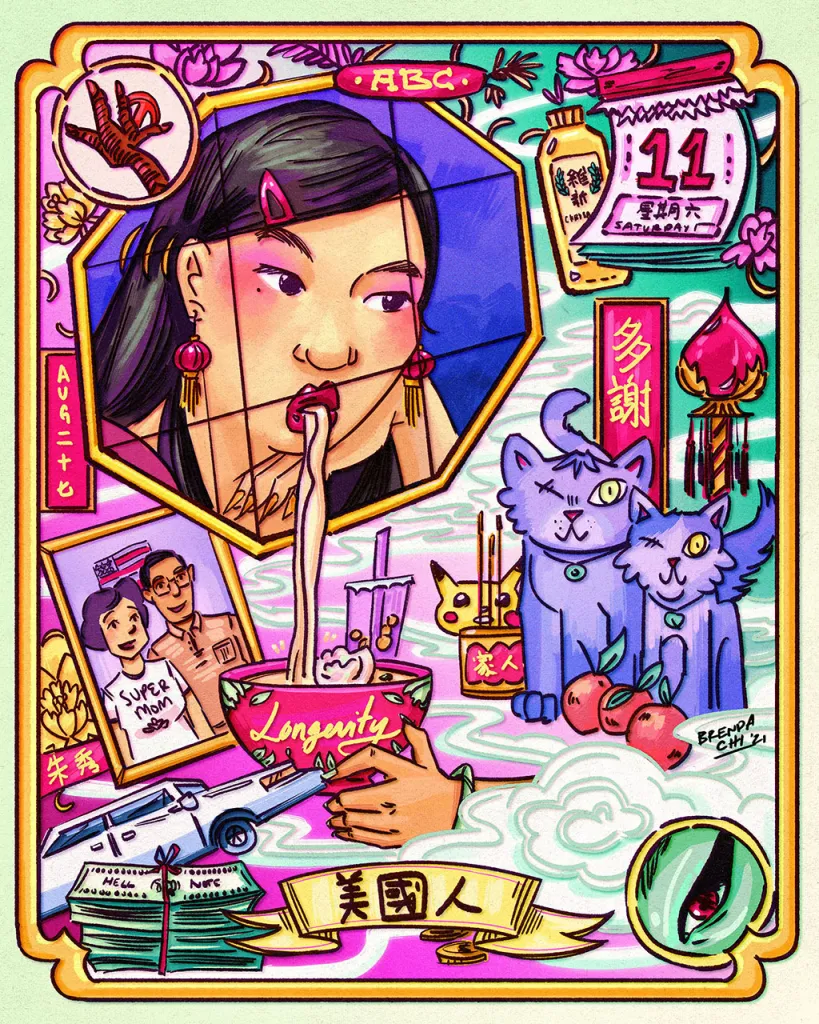
Brenda Chi
“I am currently comforting and celebrating my AAPI heritage through food, celebration of AAPI culture, language, and my family. This can also be seen as a self-portrait, as much of my identity is being an AAPI artist, so everything connects. This illustration features some of my favorite childhood foods, listening and speaking in Cantonese, celebrating my ancestors’ beauty through my self-expression, burning joss paper, praying to my family to wish us well, gratitude to my family, and claiming my space as an American Born Chinese (ABC) woman. This piece is inspired by vintage Chinese cigarette advertisements, which I’ve interpreted into a more intentional Chinese American illustration, with colors inspired by Cantonese Rose patterned porcelain. As a second generation Chinese immigrant, I often find myself researching my own Cantonese heritage as much hasn’t been taught to me. As I create this art, I am also learning about my AAPI heritage, which I think is really healing for anyone in Asian diaspora.”
Brenda Chi is a multidisciplinary artist and art director based in Los Angeles. View more of Brenda’s work here: Portfolio / Instagram.
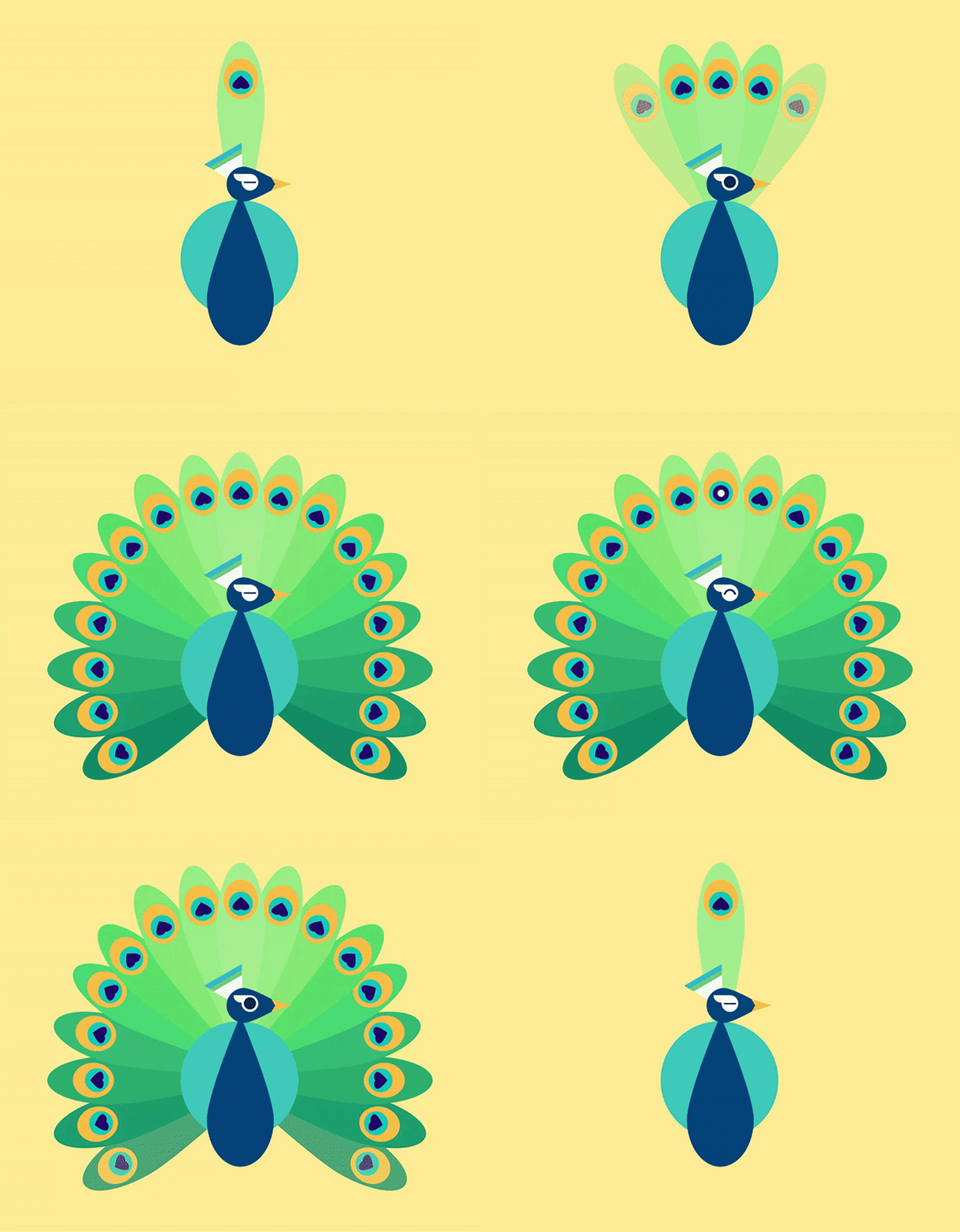
Ameena Fareeda / Eye Open at the Close
“Growing up Indian-Asian American, there were many instances in which I struggled with connecting to my identity. I would feel as though I played tug-of-war with my own Asian and American personas. As I got older, I learned to appreciate my culture and identity as a proud Asian American. The peacock is the national bird of India which symbolizes race, pride, and beauty. A peacock’s feathers are truly iconic. They spread not only for mating purposes, but also for means of boasting and protection. The feathers’ resemblance to eyes are known to be a symbol to ward off bad luck and attract positivity.
Eye Open at the Close represents how I navigate in today’s society as an Indian-Asian American. In light of the recent increase in hate crimes towards the AAPI community, it is vital to preserve and uplift the diversity, strengths, and uniqueness within the community. Eye Open at the Close raises awareness to the public eye and expresses how strong and beautiful the AAPI community truly is.”
Ameena Fareeda is an illustrator and designer based in Silver Spring, Maryland. View Ameena’s work here: Portfolio / Instagram.
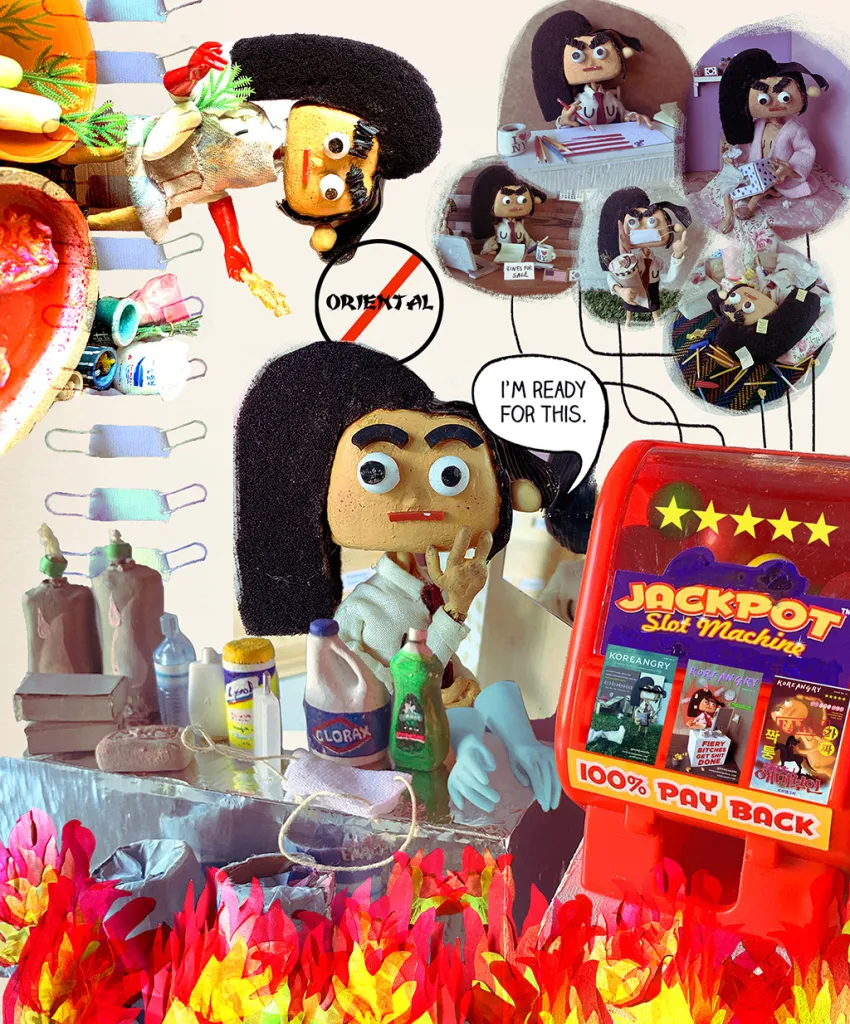
Eunsoo Jeong / Koreangry
“I’ve been making zines since 2016, and it has been my way of expressing myself. It started as a means to cope with my anxiety and depression but over the years, I’ve gained the confidence to own those narratives and turn it into humor. As a formerly undocumented immigrant, I had a hard time connecting with my identity as an Asian American, because I didn’t see many undocumented Asian Americans and didn’t know how to celebrate or to have pride within myself. In early 2020, I published Koreangry zine issue #8, that featured my Korean American history timeline after conducting self-driven research to understand and see what my roots were in this country. This showed me different perspectives on how we can define our identities regardless of what we are told to believe based on our immigration status in this country. By making zines based on my life experiences, I was able to connect with lots of AAPI folks across the country who could relate to my stories. During the grueling pandemic year, I felt isolated and lonelier than usual. Throughout that time, I pushed ideas that may challenge our AAPI communities (confronting anti-Blackness, defunding police), provided educational and informative comics (know your rights during protests, bystander intervention), and shared vulnerable confessions of my struggles and experiences living in this country today.
This artwork is a collage of my yearning desire to do ‘good’ despite the challenging struggles of being an immigrant today during the pandemic––the pressure of being a good, kind, nice, humble, grateful, by-the-book immigrant. Sharing my story through zine-making is how I connect with other AAPI groups, by accepting and rejecting, challenging, rebuilding, and redefining what our identities could be.”
Eunsoo Jeong is an artist based in Los Angeles. View more of Eunsoo’s work here: Portfolio / Instagram.
By creating art we honor our ancestors, respect our cultures, and learn about other cultures. Creating art is a way to promote peace and freedom of expression. It joins forces, strengthens roots, and leaves a wider and beautiful landscape for future generations to enjoy. Art is our voice, heart, and soul, to create art means to be present with all of who you are.
Healing can take many forms, through movement, through sound, or through visual expressions; art has been used to speak when words can not. Since the Covid-19 pandemic many Asian Americans have taken up different forms of creative and artistic approaches in combating trauma and fostering healing. In this blog post we will share a few pieces of visual art that paints a picture of hope, healing, and identity.
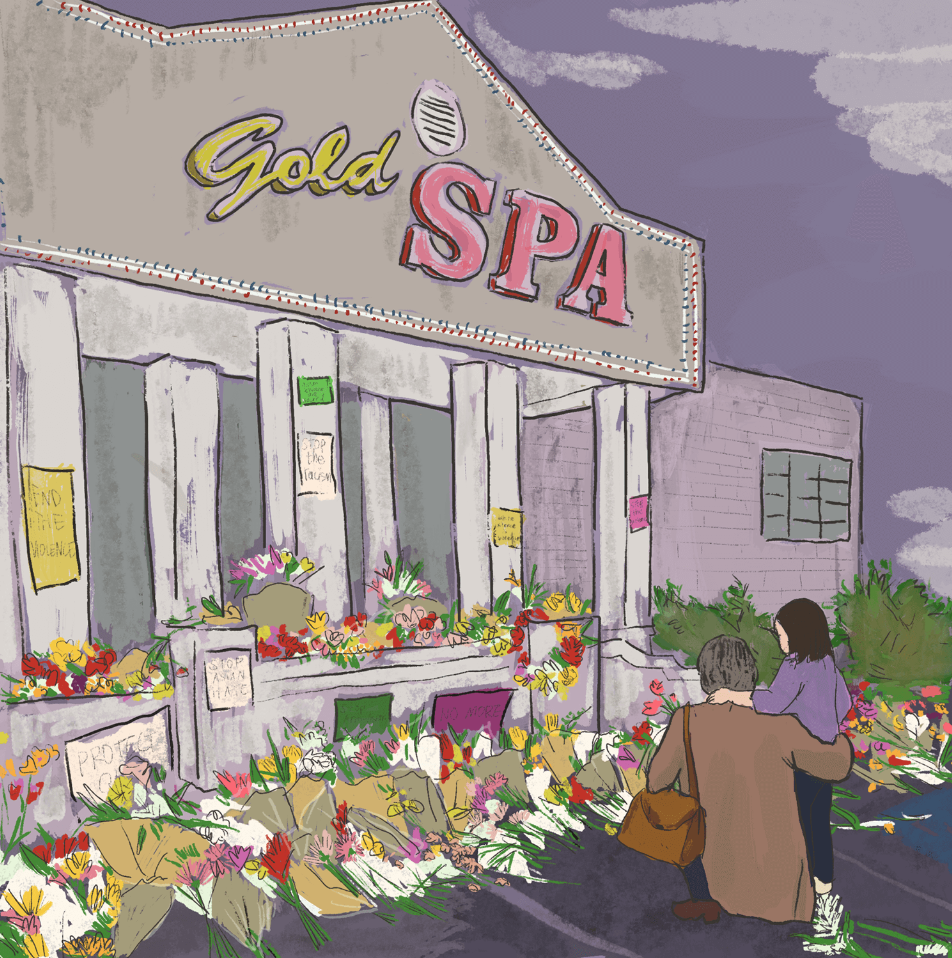
Nicole Kang Ahn (b. 1988) Remembrance, 2022 Digital print on Polyvinyl Chloride (PVC)
Remembrance is based on a photo taken by the artist during a visit to the makeshift memorial at Gold Spa in the days following the shooting. Itcaptures a moment of quiet reflection – a young girl and her grandmother lean on each other for support, surrounded by flowers and handwritten dedications. It is a reminder that while our wounds are intergenerational, so too are the ways we show caring and healing.
“I wanted to first remember the victims.”
Nicole Kang Ahn (b. 1988) is a painter, illustrator, and muralist from Peachtree Corners, Georgia. Her art means to slow down time and capture mundane moments, savoring each feeling and memory. Her three pieces included in this collection seek to tell a story that remembers the victims, honors their lives, and conveys a message of hope.
Image Description: This artwork is about remembrance. This is an illustration of the Gold Spa store front where an altar of community notes and flowers are sprawled across the front of the spa and an elder with short dark hair, a brown long sleeve shirt, and brown bag is kneeling and embracing a young child with brown shoulder-length hair, wearing a purple long sleeve shirt looking towards the altar. The Gold Spa was the site of one of the shootings that took place on March 16, 2021.
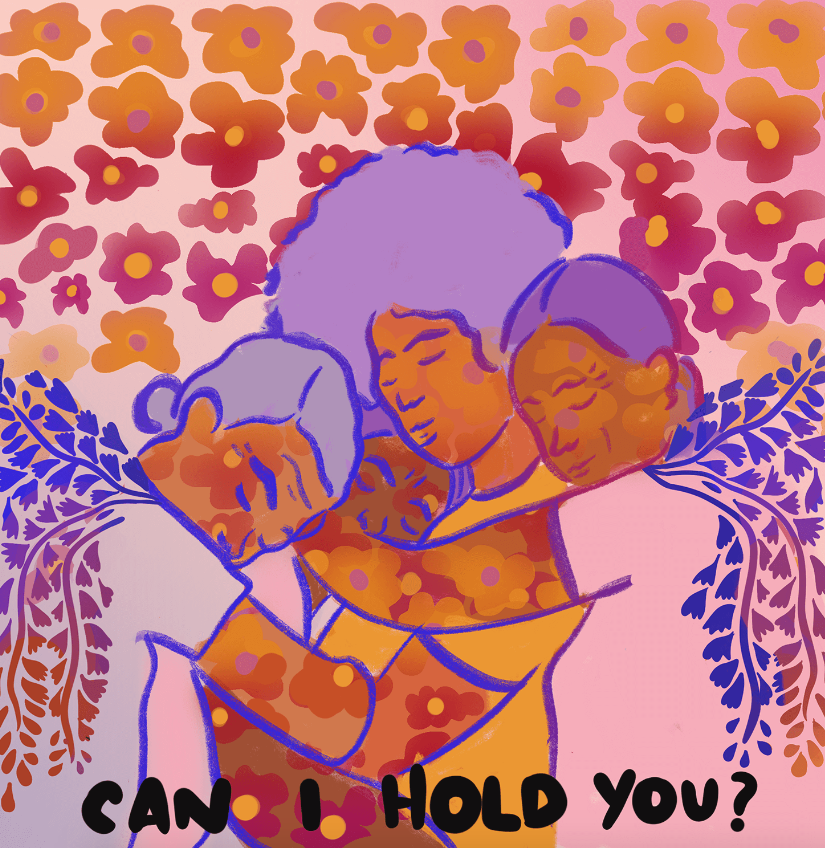
Natalie Bui (b. 1992) Community Care, 2022 Digital print on Polyvinyl Chloride (PVC)
In Vietnamese, the expression “chia buồn” is used to express condolences. “Chia buồn” literally translates to “divide sadness.” The expression captures the act of dividing grief – of cutting it into small, little, pieces to split among each other so that each of us individually carries a much lighter load. Community Care shows four figures locked in a comforting embrace. Their limbs are entangled and each person leans on the collective, both resting upon and supporting those around them.
Community care requires us to harness our power, privilege, and empathy to uplift the people who are both in and out of the reach of our embrace. In the wake of the anniversary, this piece inspires us to recommit to expanding and deepening our community of care for all, beginning in Atlanta and spreading throughout the country and the world.
“We were talking about a traumatic moment within our movement. But also trying to balance the acts of community care when these moments happen.”
Natalie Bui (b. 1992) is a Vietnamese American digital illustrator and co-Founder of SHIFT – a diversity, equity, and inclusion consultancy. Her work centers on self and community empowerment and emphasizes collective liberation across communities.
Image Description: The theme of this artwork is community care with four women embracing one another and the words “CAN I HOLD YOU?” below the image. The women appear with different hair styles in different shades of purple and different shades of orange, pink and red on their skin. There are shades of purple and blue leaves coming out from behind the two women at the end of each embrace and shades of orange, pink, purple and magenta flowers on the women’s skin. The backdrop of this image shows a gradient of orange and pink flowers.
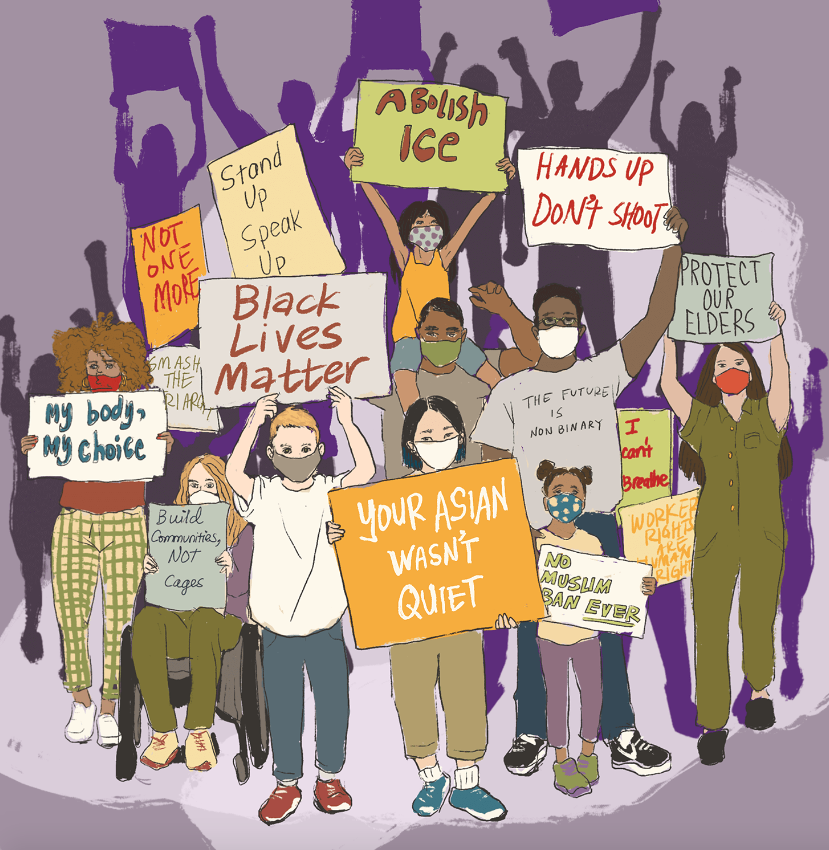
Nicole Kang Ahn (b. 1988) Solidarity, 2022 Digital print on Polyvinyl Chloride (PVC)
In this illustration, a diverse group of people of all races, genders, ages, and dis/abilities is featured in the foreground. They are holding boldly colored signs that call attention to a range of social and political issues that are often framed as separate, but are actually deeply intertwined. The shadowed figures behind them gesture to the powerful histories of resistance and community organizing that came before them. As we mark the anniversary of the Atlanta shooting, this piece reminds us that this tragedy is steeped in layers of oppression and interconnected histories of systemic violence. As such, it is a call to action to come together for a more powerful response rooted in love and solidarity.
“Gather together with other people. Align your issues and your values and do something about it.”
Image Description: This image is all about racial solidarity with a diverse group of people of all races, genders, ages, and dis/abilities holding signs that read “YOUR ASIAN WASN’T QUIET; NO MUSLIM BAN EVER; WORKERS RIGHTS ARE HUMAN RIGHTS; I CAN’T BREATHE; THE FUTURE IS NON BINARY; PROTECT OUR ELDERS; HANDS UP DON’T SHOOT; ABOLISH ICE; BLACK LIVES MATTER; Stand Up Speak Up; NOT ONE MORE; Smash the Hierarchy; My body, My choice; BUILD COMMUNITIES NOT CAGES.” The people holding up signs appear centered on the image with shades of purple shadows behind them.
The diversity within the Asian community is vast and covers many languages, beliefs, and traditions. By creating art communities join forces in shared experiences, creating a universal language that goes beyond differences. Art unifies diversity within the Asian communities by sharing narratives, personal expression, and one’s own personal journey. Embracing art as a form of healing gives birth to the celebration of one’s own cultural heritage, diversity, and resilience.
This blog post will share the experiences of, culture, and identity of 11 Asian-American artists.
Violence and racism towards Asian-Americans is not new in the United States, it laid hidden in American society until the Covid-19 Pandemic brought it out, revealing the deeply ingrained hate in the U.S. Many Asian Americans have been blamed for the Covid-19 virus, rising hate crimes and incidents of targeted violence were also on the rise. The term “Asian American” covers many cultures within the Asian diaspora, and it must be noted that these cultures have their own unique traditions, practices, languages, and identities. One can not group all Asian peoples together under one group because there are differences culturally and linguistically. These portraits share the complex expressions of Asian identity, representation, and culture by using art as a vehicle of expression.
“My parents are among many other Asian parents who cannot express their feelings/love straight. Before I grew to understand that, I hardly felt loved. Instead of saying “Good job” my parents would say sarcastically I could be better. After I grew up and absorbed more American culture. I learned to be more expressive, and I started to appreciate my parents’ subtlety of expressing love. It’s quiet but it’s stronger.”
Shuhua Xiong BORN IN SHANGHAI, CHINA TO CHINESE PARENTS
“My Asian-American experience is defined by memorizing the lyrics to Jay Chou songs without knowing their translations, and learning how to play mahjong, because my Mandarin proficiency starts at Chinese numbers and stops at cardinal directions. The exciting part is that one’s relationship to culture is never clearly defined. It ebbs and flows; it is constantly evolving.”
Gabrielle Widjaja AMERICAN BORN TO CHINESE-INDONESIAN PARENTS
“Like many children of immigrants, I was taught the value of good work ethics by watching my parents toil and overcome endless hardships. I believe I am celebrating my Asian-American culture and honoring my parents as well.”
Sally Deng AMERICAN BORN TO CHINESE PARENTS
“Public school was my first exposure to Western customs. I learned English in school and spoke Cantonese at home. I ate cafeteria PB&J for lunch and rice for dinner. I don’t remember a time where the duality of my identity was not on my mind. I felt a stronger desire to return to my roots. It’s a shift I’ve witnessed not only in myself, but in Asian-Americans as a whole. In the last couple of years we have become more visible and more heard. It has made me feel less alone and injected me with more pride.”
Joan Wong AMERICAN BORN TO HONG KONG PARENTS
“My mother is Chinese, my father is American. I spent my childhood on the tropical island of Taiwan. Years later, when we moved to the States, I would become obsessed with how others would perceive me. In many ways those memories growing up in Taiwan really formed my identity and left a strong impression on who I am today, even after making my own path all these years later. My identity has become one of the things I’ve thought about my entire life.”
Josh Cochran CHINESE-AMERICAN BORN IN OREGON; LIVED IN TAIWAN
Art is a powerful tool of expression, it can be emotional, it can tell a story. Color and brush stroke fused with the vision of the artist creates a vivid image for viewers to ponder. These portraits capture the life stories, challenges, and cultures of the artist.