Trauma Information

Trauma can be defined as a physical injury or a painful experience. It can be a factor that can cause serious damage to someone’s mental and physical health. Trauma comes in different types and forms so people experience them differently. It’s important to be informed about this issue because understanding how trauma can impact people will allow us to better understand how it changes them. Here are some factors that can cause trauma:

  • Violence that is found in a home, a relationship, and outsiders such as friends, bullies, etc.
  • Physical damage/abuse to someone’s body that have a lasting after effect such as rape, a car accident, etc.
  • Death of a loved one
  • Natural disasters that can destroy people’s home and as a result, people have to be relocated

Being able to recognized if someone is traumatized by their experience will help them solve/confront their problems. Of course, it doesn’t mean everyone is able to do that so easily or quickly. It often takes time, consultation, and maybe the help of others like medications, programs, and professional help. How you will know if someone is going through their emotional state and behavior act such as:

  • Mood swings, temper, denial, and responses to daily actives/conversations
  • Anxiety
  • Having a hard time concentrating
  • Sleep disorders such as excessive nightmares and loss of sleep
  • Eating less/more than usual

It is important to treat people with trauma to ensure that they will recover through the process sooner. It may take weeks to months to years for people to overcome their traumas. But we should always try to help others cope with their traumas so they can also return to their usual life.

Here is another great source to check out for more information about trauma.

Family Communication

Family is a support system that can help us get through many stages of our lives. It takes great understanding and communication to work together through different challenges. Sometimes it is hard for us to talk to our families or have them support us in the ways we want them to. But of course, your family is there to help you in any ways they can. Here are some tips on communicating with your family members in positive ways:

1. Be open-minded and understanding of others. Although everyone in your family may share different opinions, it doesn’t mean they’re against you. Often time, talking things out will help people come to terms of understanding your situation. Try to avoid being narrow minded because it won’t solve anything.

2. Share your life with them. Being part of a family means you share and make memories with them. You don’t share every aspect of your life with them because everyone has separate experiences in life. By sharing little daily things (over dinner, a movie, etc.) with them can help you reconnect with them at the end of the day.

3. You have a problem? Address it now; sooner is better than later. If you’re struggling with something, then don’t let it drag on. By the time you realize what you could have done by asking your family for help, it may be too late. Your family will help you if they are able to, but don’t take them for granted.

4. Always be grateful for them. Whether you like your family or not, be grateful for your family. You wouldn’t be who you are without their influence, support, and love. Not every family is perfect and that’s okay. You’ll learn over time that family is something that always stays with you for a lifetime.

5. Enjoy their company! Hey, time will fly before you become independent yourself. You’ll realize that your life with your family was really short compared to the other years you’ll continue to live with your own family. So really take the time to make more memories and enjoy being with your family.

Understanding Substance Abuse Challenges

People who have gone through substance abuses are often misunderstood in many ways. Some may not understand why they do what they do or why can’t just stop. There are many different level of reasons why because everyone’s situation is different. Also, it requires other people in their lives to be understanding without being judgmental like families and friends. If you know somebody who may be going through substance abuse challenges or yourself is going through that, here are some tips that could help you out:

Identify the problem. You can only start helping yourself or someone else in need if you properly know what they’re struggling with. By helping others/yourself to acknowledge that there is a problem is not something to be ashamed or embarrassed about. Substance abuses can increase or be results of stress, anger, addiction(s), emotional distress, unhealthy treatments, or more. Problems could lead to bigger issues and early help can prevent more negative things from occurring.

Communicate with people. Talking things out well help sort out the emotions they’re facing and you understanding their situation more. With yourself, you can talk to families, friends, or seek professional consultation. Being able to have another person’s perspective on your struggles can help you understand the situation more.

Take the step to seek for help. There are so many resources out there in the U.S. to help people face/solve their issues. In today’s world, established centers will definitely help anyone out if people reach out to them. Sometimes, it’s really up to those people or yourself to help themselves. Remember that people are willing to help you or someone you know who needs help.

Here’s a link to another credible source for extra information.

Mental Health in Youths

Mental health in youths is an important part of development and understanding the world around them. It impacts youths on how they adapt to new situations and perceive life. Different situations allows youth to develop in self improvement, morals, sense of justice, and more. Remember that it is important to take care of your psychological health because it directly impact your feelings, moods, physical body, responses, actions, and more.

According to http://www.findyouthinfo.gov/, youths that are able to develop their mental health in positive ways can help:

  • navigate successfully the complexities of life
  • develop fulfilling relationships
  • adapt to change
  • utilize appropriate coping mechanisms to achieve well-being without discrimination
  • realize their potential
  • have their needs met
  • develop skills that help them navigate the different environments they inhabit

If you are going through or know someone who may need the extra support and understanding, make sure to reach out for help. There are so many ways to help guide someone or yourself to have a healthier mentality. Another source to look at with many information about this topic is here.

Youth & Human Trafficking

Human trafficking is a serious crime that is still happening today all around the world and in the U.S. It is the second biggest illegal trade in the black market after the drug trade. Victims of females and males can be found in this industry from as young as 12-14 years old. It is a form of human slavery that traumatizes and abuses people’s human rights.

To prevent more victims, we can try our best to recognize if someone is in a vulnerable position to be possibly become involved or lured into human trafficking. Note that different situations can lead people into this industry by:

  • Kidnapping
  • Homelessness
  • Friend/relative/anyone’s influences
  • Luring/trap by someone suggesting they’ll try to “help” out
  • Prostitution

There are many things we can do to help victims such as supporting them financially, emotionally, and through consultation. We want the victims to be able to support themselves and enjoy the joy of lives as everyone else. Human trafficking charities and programs really tries to help these women and men to have a better life. Here’s how you could help someone and/or get involved in this fight against human trafficking.

Source: http://www.findyouthinfo.gov/

Local Human Trafficking charities and organizations in Minnesota: http://mnhttf.org/human-trafficking/organizationsproviders/


Teen Pregnancy Prevention Methods

If you ever decide to be sexually active, the are multiple ways for you and you partner to stay protected. First thing you need to consider and learn about is that you are putting yourself at risk for pregnancy and other possible risks. Therefore, it is rather wise to use protections to reduce those chances.

  1. Get tested! You may want to know if you and your partner are have any STDs or possibly (higher) risks of getting pregnant, a STD, and more. If you want to be physically involve with someone, note that your are exchanging bodily fluids between them. Therefore, make sure you and your partner are safe to be sexually active. You don’t want to be sexually involve with anyone who could infect you.
  2. Go to your local clinic or school clinic! It’s wiser to get consultation and you will need a doctor/nurse’s permission to get any type of pregnancy prevention. These people will keep your information confidential and only the clinic will know about your situation. They can help you get the resources you need to be sexually active (usually at a cheaper price) at a young age such as condoms, birth control pills, and more. You will feel more comfortable and confident with your body knowing that you are preventing pregnancy.
  3. Plan out which pregnancy prevention method is best for you! There are many ways to prevent pregnancy, but not all is fit for everyone. But know that all of these methods ranges from affordable to expensive. Don’t worry about sticking with one choice, you can always change it depending on how your body responds to them.

Get tested at your local clinic or at your school clinic.

get-tested

Use protection! There many contraceptives options for teens to use. If more contraceptives are used together, the better chance it reduces pregnancy.

These suggested pregnancy prevention options are listed due to it’s most common option, lower price, and easy access.

Barrier Methods

  • Female condom
  • Male condom
  • Diaphragm (inserted into the vagina with spermicidal cream before intercourse which blocks sperm)

diaDiaphragm

Hormonal methods

  • Birth control pills
  • Contraceptives patch (sticks to the skin of buttock, lower abdomen, outer arm, or upper body which releases hormones through the skin into the bloodstream)

patch [lacesContraceptive Patch

  • Birth control injection (injected to arm or buttock once every three month)
  • Implant rods (implanted rods which are inserted surgically into the upper arm; can last up to 5 years)
  • Emergency Contraceptives Pill is used after unprotected intercourse up to 2 days and is not a pregnancy prevention method for daily use

There are other methods like IUDs, vaginal ring, and more, but those are not as common in teens. These are just the few most common and popular pregnancy prevention methods out there for youths.

Image Source:

1. http://albahelpinternational.blogspot.com/2011/12/contraceptives.html

2. http://albahelpinternational.blogspot.com/2011/12/contraceptives.html

3. http://teentalk.ca/issues/stis/ways-to-stay-safer

Runaway Prevention: Communication

There are many reasons why youth homelessness occurs, but one solution that could prevent this from happening is effective communication. By understanding the other person’s situation and being supportive, you can help advise them not to run away from home or instead, seek refugee in supportive programs relatives, friends, and more. 

  • Being understanding is key to know how you can help somebody. Sometimes what youths really need is someone they can talk to without feeling or/and being judged. They may like having someone to talk to about solving the issues of they have and your input could possibly lead them to make a better decision for themselves.
  • Try to get youths to discuss their problems with their direct families. Sometimes, youths may not feel supported in their struggles and feeling neglected can make them feel unwanted at home or have the desire to leave home. Although both side may share different perspectives, it is all about understanding one another. Through that, youths and families can learn how to positively help each other in different ways.
  • There are other ways for youths to be supported if they are not by their families through relatives, friends, guardians, youth programs, helpful phone lines, and more. You can advised them to look for other options that is safe and trustworthy besides running away from home.
  • Prevention of youth runaways can help them avoid other possibly dangerous situations/risks. Such as experiencing homelessness, substance or/and sexual abuse, human trafficking, pregnancy, trauma, and more.

By effectively communicating with youths, we can help solve their problems and give them more options than what they know. If we can prevent youths from becoming homeless and give them a place to solve their concerns, they will be able to have a more positive outlook on their lives and have the opportunity of a better future.

Korean Americans

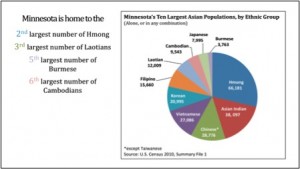
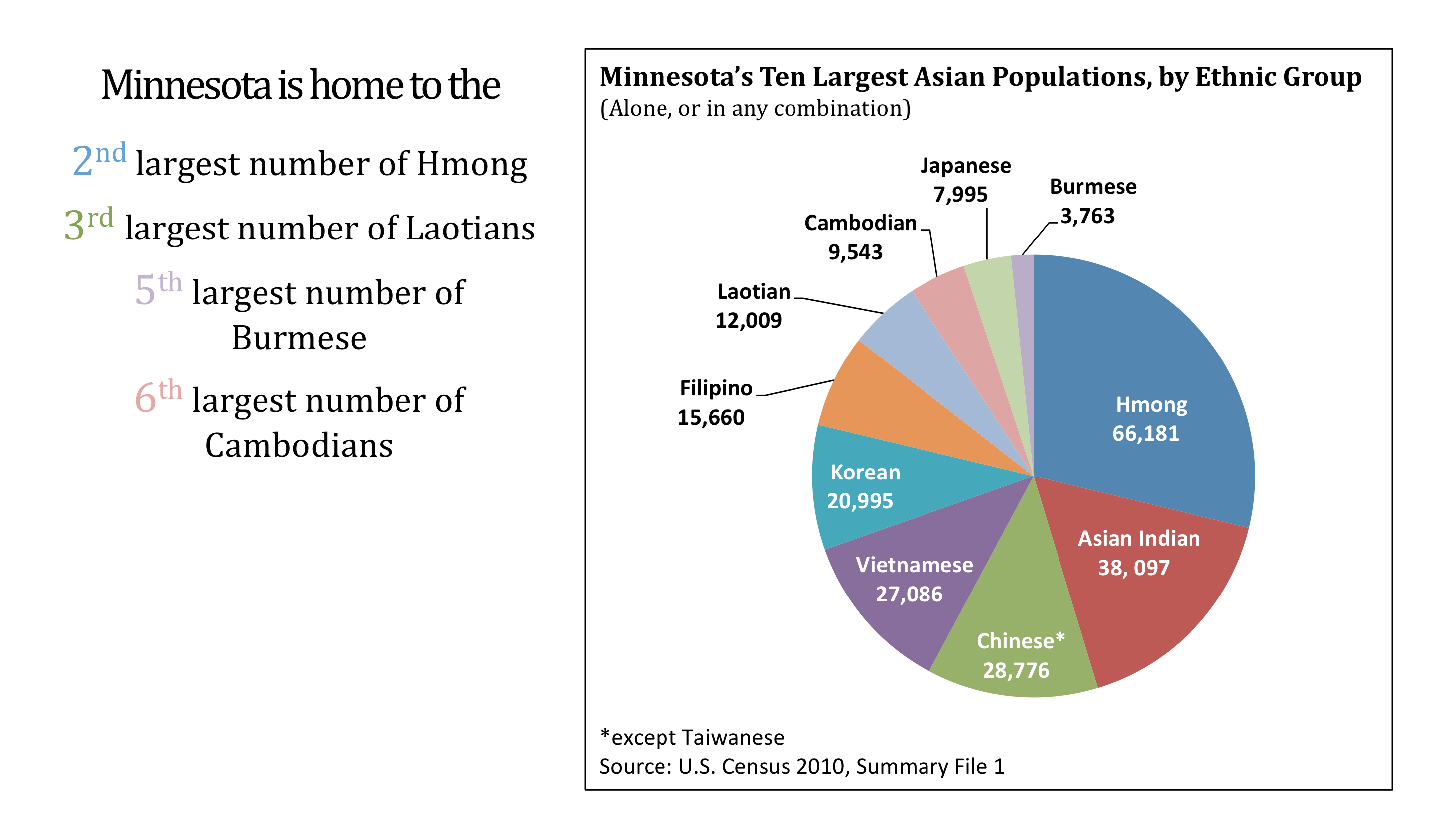
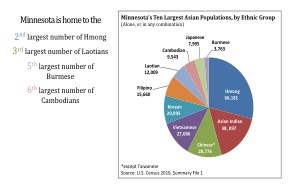
According to the 2010 U.S. Census the eight largest Asian American populations in Minnesota are the Hmong, Asian Indian, Chinese, Vietnamese, Korean, Filipino, Laotian, and Cambodian communities. Specifically, 27 percent of the total population identify themselves as Hmong, 15.5 percent are Asian Indian, 11.7 percent are Chinese, 11.1 percent are Vietnamese, 4.9 percent are Laotians, and 3.9 percent are Cambodians (See Figure 2).

Minnesota is home to over 40 different Asian Pacific Minnesotan immigrant and refugee communities. Each community has its own strengths and challenges that may be unique to that ethnic community. The following is an overview of how the Korean American community is faring in Minnesota.

Korean American Community Overview chart

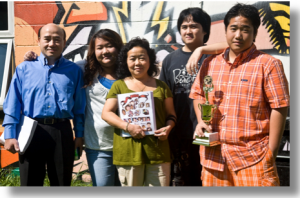
The Korean community in Minnesota is defined by three distinct populations: Korean immigrants who came to the state as wives of U.S. servicemen following the Korean War, Korean immigrants drawn by educational and professional opportunities, and Korean adoptees who were brought to the state by Minnesotan families after the end of the Korean War.[i] There are about 13,000 to 15,000 Korean adoptees in the state.[ii] Most members of the Koreans community in Minnesota are professionally employed with a median household income of $60,984.i   APA ComMNet REACH CORE project staff and volunteers met with Korean American community members and leaders throughout the Twin Cities to understand the community’s strengths, challenges and other social and environmental factors affecting its overall health and well being.

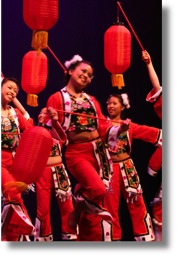
 korean dance

Korean American Community Strengths

In general, the Korean American community perceived its quality of life in the Twin Cities as one consisting of increasing financial wellbeing and higher educational and professional attainment. Ample activities and opportunities exist for Korean Americans to be academically, financially, and socially healthy.   Korean American members who participated in the project said they were proud of the their community’s academic and professional achievements. More than half of the Korean American population over the age of 25 years old in the state has a college or professional degree and only 6.3 percent are unemployed.i   As a guest in the Korean Radio show stated, “Many Koreans in Minnesota have professional jobs. High education standard is one of characteristics of Minnesota. A good educational environment is the most important factor too.” Korean Americans also identified having a good family relationship and relationship to the Korean community was important towards a healthy life in Minnesota. They added that maintaining a spiritual or religious practice, such as the Korean church, helps community members to be healthy.

Korean American Community Challenges

Korean American community members who participated in the project indicated that elders and newly arrived immigrants faced challenges in accessing appropriate health care services. Many stated that the lack of resources for limited English proficiency populations and affordable health insurance were among the issues that concerned Korean Americans. “Cost of private health insurance are high. Some of Koreans are still working to pay their health insurance. We have a private insurance before [turning 65 years old, when one is eligible for government subsidized health care]. We need to have solution for this,” stated one guest during the Korean radio show. APA ComMNet survey results also showed that Korean Americans were less likely to do any physical exercise or see a medical professional and were more likely to have been diagnosed with diabetes and suffer a heart attack than most other AAPI groups that participated in this project (See Figure 4).

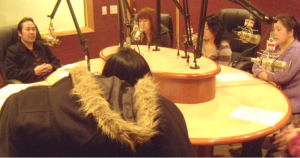
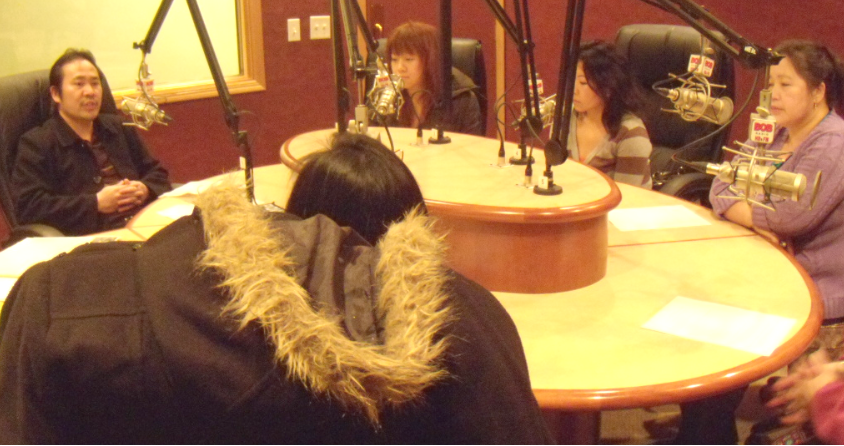
REACH CORE Radio Talk Show:

radio talk

Korean Community

Host Park: What are the three most important factors for a healthy Korean community in Minnesota?

Guest Kang: Strong family relationship, healthy life style, and religious or spiritual values are the three most important factors. Strong family relationship can improve our community in many ways like low crime rate, child education, safe neighborhoods, etc. Keeping healthy life style will be helpful for our community to become healthy. Religious values are the most important one.

Host Park: I agree with that strong family relationship is one of the three most important factors. When one’s home is happy, all goes well.

[i] Minnesota Historical Society, 2013. “Becoming Minnesotan: Stories of Recent Immigrants and Refugees.” St. Paul, MN: Minnesota Historical Society. Retrieved January 8, 2013 (http://education.mnhs.org/immigration/)

[ii] Olson, Norma Smith, 2010. “We’re From Here: New Book Gives a Visual History of Adopted Koreans in Minnesota.” Minnesota Women’s Press (September 10, 2010).


Remembering Where We Came From

ChildrenAroundtheWorld

www.digitween12-2.flatclassroomproject.org

Many of us came from our parents and our parents came from their parents and so on. Everyone must’ve came from somewhere in the world to get to the place that they are now. As time passes on, we can forget our cultural roots and traditions that has faded due to many reasons. Such as assimilation, none to very little exposure to our own cultural heritage, or/and untold/forgotten stories, values, folktales, and traditions.

Thankfully, we have many resources nowadays if we want to learn where our ancestors come from, where they live, and such. But the real reason why it’s important to know your own cultural background is because it has to do with your identity. It is about learning more about your ancestors and understanding that as an individual, you and everyone else all connect somehow and are a part of a bigger world.

For example, the struggles of our ancestors directly impacts us how we may live life or make decisions today because we learn from our right and wrong choices. Idealistically, people like to become more advanced/better over time and without our ancestors going through the challenges that we didn’t have to, our present lives was made easier by little factors.

Some people in your life like your parents, grandparents, and elderly relatives had to go through hard times to provide for their families and themselves. Whether it was giving up their own education to find a job, leaving their home country to emigrate to a different country, sacrificing their time to invest in their offspring, and shedding blood, sweat, and tears for the sake that everyone present today has a better life and more opportunities.

Also, it is thanks to our ancestors that today the world have so many different kinds of ethnic groups, languages, religions, civilizations, and intellectual knowledge about life, space, animals, and more. Our ancestors made some impact in the future where we can arguably say that we do live in a better world in some aspects.


Holidays From All Over the World

There are many countries that the U.S. don’t share holidays with and it’s nice to know what we miss out on some of the great things people celebrate from all over the world. Here’s a list of cultural groups that have their own unique holidays.

1. Thailand – Songkran

a_Chiang-Mai-Songkran-Fest-a

http://www.hellomagazine.com

One of the many celebrations of Songkran involves people splashing each other with water in the hot weather. “Part of the ritual was the cleaning of images of Buddha. Using the ‘blessed’ water that cleaned the images to soak other people is seen as a way of paying respect and bring good fortune.” – http://www.officeholidays.com/

2. Malaysia – Malaysia Day

1280px-Hari_Malaysia_celebration_in_2011

http://en.wikipedia.org/wiki/Malaysia_Day

The holiday day title is literally what the holiday stands for. The people of Malaysia celebrate the day “16 September 1963, when the former British colony of Singapore and the East Malaysian states of Sabah and Sarawak, joined to create the Federation of Malaysia” – http://www.officeholidays.com/. It’s for everyone to take pride of Malaysia and its historical events of the people and country gaining independence.

3. Japan (including other Asian countries) – Childerns’ Day

kinryu_main

www.cheng-tsui.com

Yes, there is a national holiday to celebrate children with gifts, food, blessings, and wishes. Also, it is a time when parents pray for the best in health and success for their children.

4. Korea – Hanguel Day

Spectators gather in front of a bronze s

http://asiasociety.org

In celebration of the development of Korean alphabets after the colonial rule of Japan. “King Sejong the Great who was the fourth monarch of the Joseon Dynasty, devised and proclaimed the Korean alphabet in the 15th century” – http://www.officeholidays.com/. Korea did not develop their own alphabets as early as other cultural groups due to strong influence of the Chinese and Japanese characters.

5. Indonesia (including other Asian countries) – Waisak Day

wesak

http://www.borneoexplorertours.com

A national holiday made in name of Buddha’s birthday, death, and enlightenment. A ‘holy day’ for Buddhists monks and Buddhism believers that celebrates the life of Buddha. The holiday allows people to pray, receive or/give blessings, cleanse one soul and mind, make offerings, and display beautiful lights.