
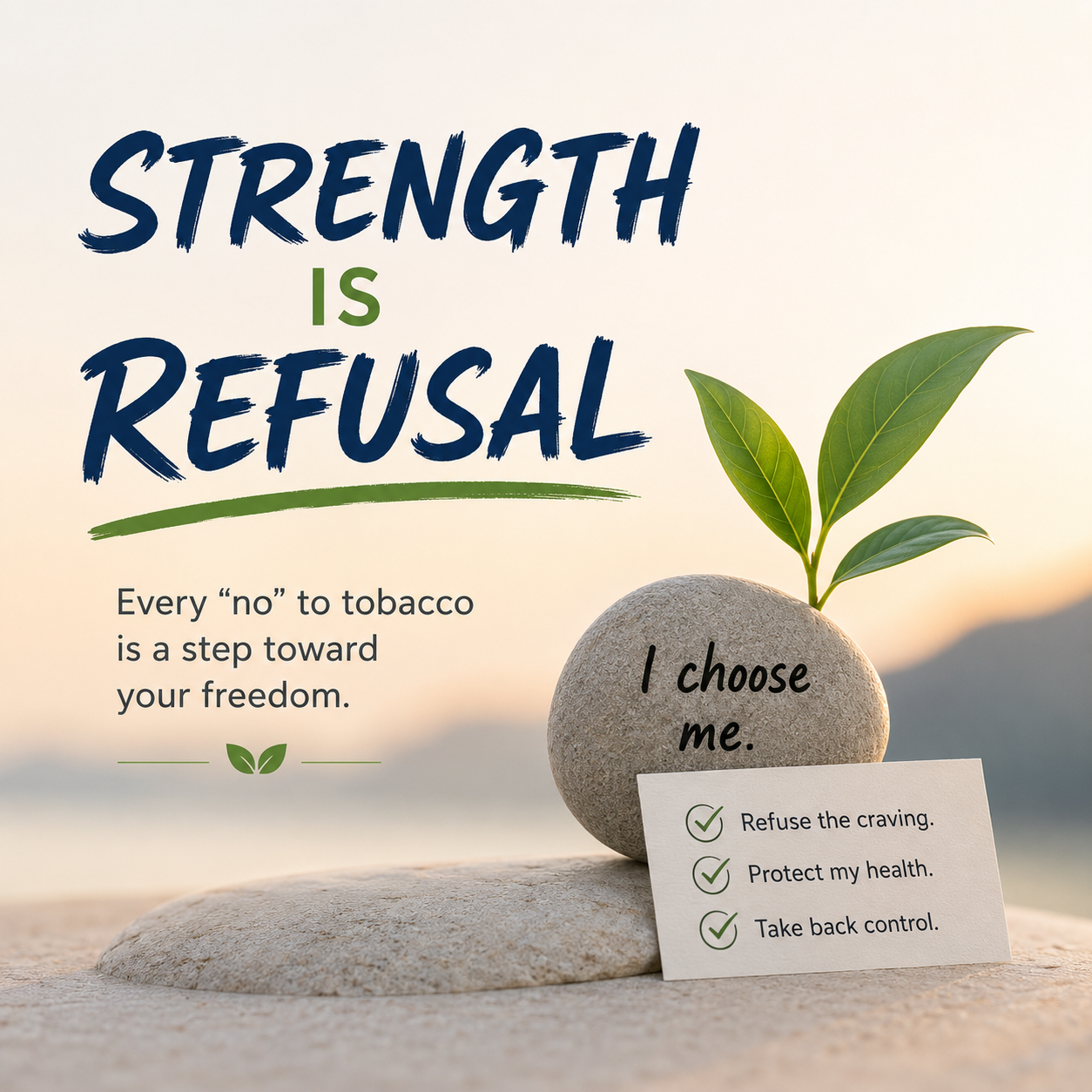
Strength is Refusal

Strength Is Refusal

You are stronger than you think. Stronger than the craving. Stronger than the habit. Stronger than the lie addiction tells you every single day.

That lie is a quiet one. It doesn’t announce itself. It whispers that you need it to relax, that you can’t get through the day without it, that quitting is something other people can do — just not you. It clouds your judgment and convinces you that giving in is easier than pushing back.

But here’s the truth: strength was never about lifting the heaviest weight or running the fastest mile. Sometimes strength is simpler — and harder — than that. Strength is refusal.

Refusal to give in to addiction.
Every time you say no to a cigarette, you’re not weak for craving it — you’re strong for resisting it. That moment of refusal, repeated daily, is what breaks the cycle addiction depends on.

Refusal to hurt your health.
Your lungs, your heart, your body — they are worth protecting. Tobacco doesn’t ask permission before it damages you. But you can decide, every day, that your health matters more than the habit.

Refusal to let tobacco take control.
Addiction thrives on control — convincing you it’s calling the shots. But the moment you push back, you take that control back. One decision at a time, you decide who’s really in charge.

Do not let the addiction cloud your strong will. Push tobacco away. Not because it’s easy, but because you are capable of it — more capable than the lie wants you to believe.

You don’t have to do this alone.

If you’re struggling and need someone to talk to, support is available:

📞 1-800-QUIT-NOW (1-800-784-8669) — the National Quitline
🌐 smokefree.gov
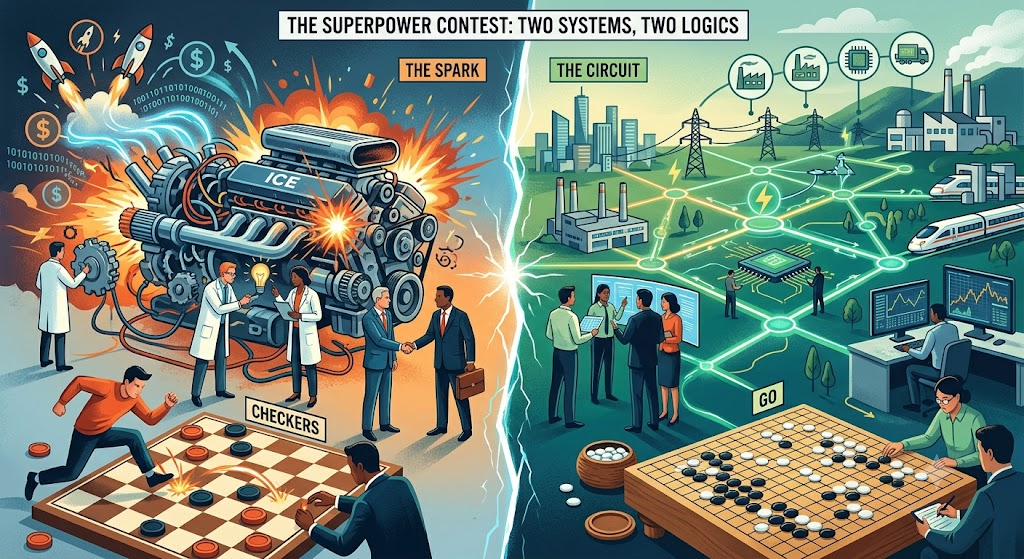
Two Systems, Two Logics in the Superpower Contest

By Joel Wong, Board Member of AAUC, Co-Chair of the Asian American Stories Video Contest & Chair of the Judges Committee, Silicon Valley Community Media (SVCM)

The U.S.-China rivalry is a profound structural collision between two distinct operational architectures and strategic playbooks.

The Operating Systems: Spark vs. Circuit

  • U.S. — Internal Combustion Engine: Driven by high-risk venture capital and creative disruption, the American model acts as an ignition chamber for radical technological breakthroughs. However, it is highly volatile, prone to asset bubbles, and fractured by political polarization, leaving Washington struggling to scale and manufacture its innovations domestically.
  • China — Integrated Smart Grid: Beijing synchronizes state-owned enterprises, private tech giants, and macroeconomic blueprints into a unified conductor. It dynamically reroutes resources during external shocks to achieve unparalleled industrial scaling, but it risks centralized fragility and favors incremental optimization over revolutionary discovery.

The Playbooks: Checkers vs. Go

  • U.S. — Checkers: Focuses on direct confrontation, rapid tactical captures, and reactive crisis management via targeted sanctions, military deployments, and mini-lateral alliances. It excels at fast responses but lacks long-term structural continuity.
  • China’s — Go (Weiqi): Prioritizes patient spatial encirclement, cumulative advantage, and building enduring global infrastructure networks. While highly resilient over decades, this bureaucratic strategy is vulnerable to sudden, non-linear black swan events.

The Hybridization Race: The contest is fundamentally an operational duel moving toward hybridization. The U.S. is deploying aggressive industrial policies to build its own grid, while China pours state capital into foundational tech to ignite its own spark. The ultimate victor will be the superpower that successfully executes both strategies: fusing high-velocity disruption with systemic, long-term endurance.

Visit joelwong.net.