Today’s Health Topic: Coronary Artery Disease

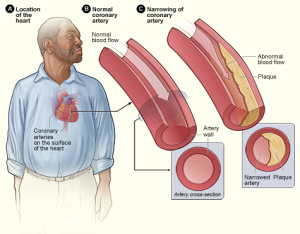
The most common type of heart disease in the U.S. is coronary artery disease where cholesterol leaves deposit of plaque and it contributes to plaque build up over a period of time. Most people don’t know that they may have this disease unless there is a heart attack or possible early signs.

atherosclerosis_2011

www.nhlbi.nih.gov

Being aware of the symptoms can give people more information on how to identify if they may have this heart disease:

  • Chest pain that could frequently occur in your upper body and back
  • Short breaths where your body is leaving lacking oxygen due to the slow or very little blood flow from your heart
  • Heart attack which means that your arteries are blocked and cause your body to be deprived of oxygen

Call for emergency help if you think that you may be experiencing some of these symptoms. So what can cause this heart disease or add more stress to the heart:

  • Lifestyle/diet is a huge factor that affects your body. If people are not active enough or/and have a bad diet, they are more likely to develop heart diseases.
  • Smoking/drugs that could another stress to the heart and affect other organs besides your heart like the lungs, stomach, liver, and more.
  • Diabetes or insulin resistance
  • High blood pressure that may be genetics, kidney problems, thyroid problems

Resource: www.mayoclinic.org


Traditional vs. Modern Diets

Before McDonalds or KFC dotted the landscape of Singapore, a small island nation in Southeast Asia, its residents enjoyed a staple of rice, meat and vegetables cooked in their Chinese, Indian and Malay traditions [i].  These days however, Singaporeans enjoy a westernized way of life that includes eating at fast food restaurants two or three times a week[ii].

Another McDonalds in China.   Photo Credit: Asian Correspondent.

Another McDonalds in China.
Photo Credit: Asian Correspondent.

Researchers at the University of Minnesota’s School of Public Health decided to find out the health cost associated with this change in diet and collaborated with public health experts at National University of Singapore.  Over 60,000 Chinese Singaporeans were interviewed about their health and eating habits [ii].  What they found was not only surprising to many in the public health community but a real cause of concern for modernized Asian countries.

Type 2 Diabetes and Cardiac Deaths for Fast Food Lovers

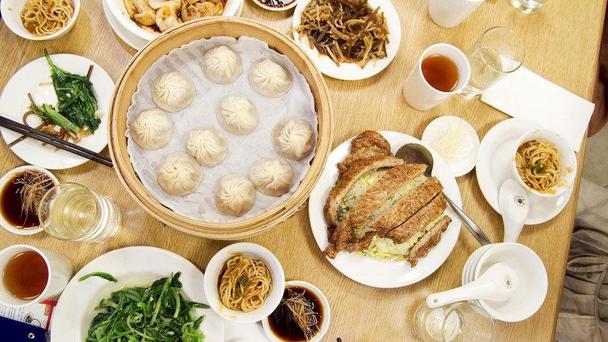
Study participants who ate more than two times a week at fast food joints like Burger King or Quiznos were more likely to die of heart disease and develop Type-2 diabetes.  These results were evident after researchers controlled for other factors such as gender, educational level and weight.  Interestingly, Chinese Singaporeans who ate traditional Singaporean meals, like stir-fried vegetables or steamed dumplings, were not at risk for acquiring these diseases.

Popular Asian Dishes. Unknown source.

Popular Asian Dishes. Unknown source.

The results of this study along with other similar research findings convinced public health, medical and nutrition experts that good health is connected to maintaining cultural traditions, especially rituals that involve cooking food in simple unprocessed ways.

The Asian Diet Pyramid

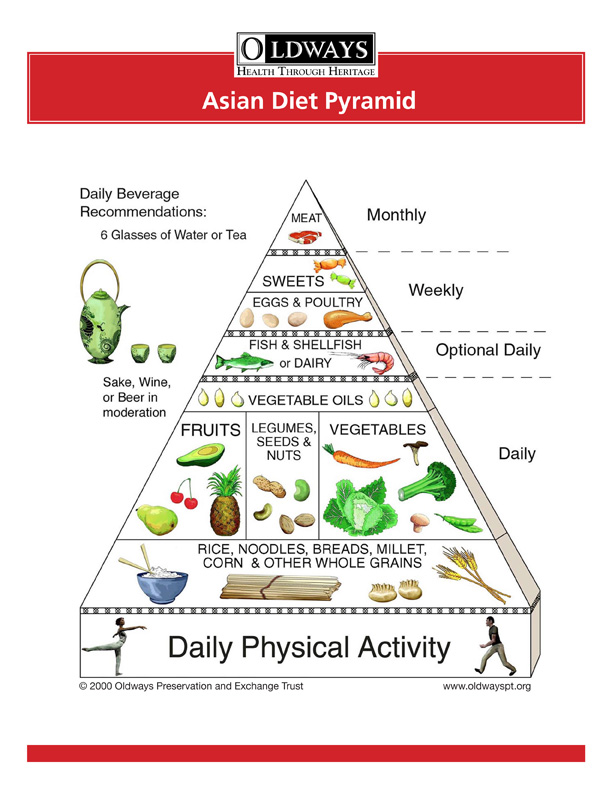
Emphasizing traditional food staples such as rice, noodles, legumes, vegetables and fruits, along with some red meat, fish and poultry, the Asian Diet Pyramid was developed by Oldways Preservation Trust to encourage healthy eating in the Asian American community.    Oldways organization is guided by a simple premise that good health can be found through heritage [iii].

Oldways Heritage Pyramid developed by Oldways Preservation Trust,conjunction with the Cornell-China-Oxford Project on Nutrition, Health and Environment, and the Harvard School of Public Health.

Oldways Heritage Pyramid developed by Oldways Preservation Trust,conjunction with the Cornell-China-Oxford Project on Nutrition, Health and Environment, and the Harvard School of Public Health.

A new generation of Asian Americans has heeded the call for returning to a more traditional diet used by their grandparents.  Young Asian Americans activists like Aileen Suzara, a Filipino American educator, environmental justice advocate and a natural chef, uses traditional Filipino food and recipes to understand and connect to her Filipino American culture and community (learn more about her here).

As more Asian countries modernize and look towards the U.S. as an example of western living, it has become evident that America’s obesity epidemic will also be exported along with the super-sized burgers, shakes and fries.  Asian Americans in the U.S. can look beyond this pattern of ordering food-to-go or eating meals outside the home and look within their own culture to find meaningful ways of achieving optimal health and wellbeing.


[i] Academy of Nutrition and Dietetics, www.eatright.org.

[ii] Western-Style Fast Food Intake and Cardio-Metabolic Risk in an Eastern Country. Andrew O. Odegaard, Woon Puay Koh, Jian-Min Yuan, Myron D. Gross, and Mark A. Pereira. http://circ.ahajournals.org/content/early/2012/05/31/CIRCULATIONAHA.111.084004.full.pdf

[iii] Asian Diet Pyramid. Oldways Heritage Through Health. www.oldwayspt.org.

[contact-form][contact-field label=’Name’ type=’name’ required=’1’/][contact-field label=’Email’ type=’email’/][contact-field label=’How did you hear about our website?’ type=’text’/][contact-field label=’Comment’ type=’textarea’ required=’1’/][/contact-form]

Who We Are…

AMA Staff at the 2012 Hmong New Year in Minneapolis, MN

AMA Staff at the 2012 Hmong New Year in Minneapolis, MN

In response to the increasing disparity in health outcomes within the Asian American and Pacific Islander (AAPI) community in Minnesota, especially among the newly arrived Asian immigrants and refugees, the bicultural healthy living concept was conceived.  This concept emerged from work initiated by the Asian Pacific American Community Network (APA ComMNet), a collaborative group led by Asian Media Access (AMA).  In 2010, AMA and APA ComMNet received a prestigious grant from the Center for Disease Control and Prevention (CDC) to participate in the REACH CORE program (Racial and EthnicApproaches to Community Health, Communities Organized to Respond and Evaluate) that seeks to eliminate racial and ethnic health disparities in the U.S.

As a member of the National REACH Coalition, AMA and APA ComMNet conducted outreach and engagement with Minnesota’s eight largest AAPI communities and collected qualitative and quantitative data to understand the systematic, environmental, cultural and social factors influencing the health of AAPIs in the state.  Guided by the MAPP process (Mobilizing for Action through Planning and Partnership), AMA and APA ComMNet found that by moving beyond the aggregated data used for AAPI communities, various cultural, historical, institutional and societal factors emerged deeply impacting the overall health of AAPIs in the state.

Along with its partners, AMA and APA ComMNet have devised a strategy that will allow the Asian/Pacific Islander culture as well as the American culture of AAPIs to co-exist with the ability to use one or both cultural protective factors when needed.  The bicultural healthy lifestyle promotes a balanced approach to living a healthy and full life.

To learn more, check out the “About Us” page…

Balancing a Bicultural Life: How it Can Improve Your Health

Young Asian American dancers during the Hmong  New Year Celebration

Young Asian American dancers during the Hmong New Year Celebration

We live in a country where over 300 languages are spoken at home and one can find a native from every corner of the world.    Built largely by immigrants, the United States is a melting pot, or a salad bowl perhaps, of varying cultures and traditions.  Leading a bicultural healthy life, therefore, is the ability of immigrants and refugees to bridge two cultures, the American mainstream culture and their culture of origin, into one that allows them to live healthfully and happily.

Right now, however, many in the immigrant and refugee community are unable to find this balance.  They are in the losing end of a battle to overcome serious health conditions such as obesity, diabetes and heart disease.  Although seen as a “model minority”, Asian Americans are struggling.  With high infectious disease rates of Hepatitis B, tuberculosis and HIV/AIDS, prevailing mental health disorders including depression, anxiety and suicidal ideation, and an increasing number of obese and overweight members in the community, Asian Americans are not immune to the social and environmental factors that has deteriorated the health of all Americans.

By encouraging a bicultural healthy lifestyle, we hope that Asian Americans can find a path that allow both their Asian and American culture to co-exist with the ability to use one or both cultural protective factors when needed.

An example of a bicultural healthy practice is encouraging Tai Chi for 30 minutes a day as opposed to walking or running on the treadmill or employing the traditional Asian staple of rice, boiled vegetables and fish as opposed to eating in a fast food restaurant. 

This blog will explore the various ways and strategies to improve the health of Asian Americans and the community as a whole by living a bicultural healthy lifestyle.

Looking forward to your comments!

Topic for the Next Blog Post: Introducing the Asian Food Pyramid

[contact-form][contact-field label=’Name’ type=’name’ required=’1’/][contact-field label=’Email’ type=’email’ required=’1’/][contact-field label=’Website’ type=’url’/][contact-field label=’Comment’ type=’textarea’ required=’1’/][/contact-form]