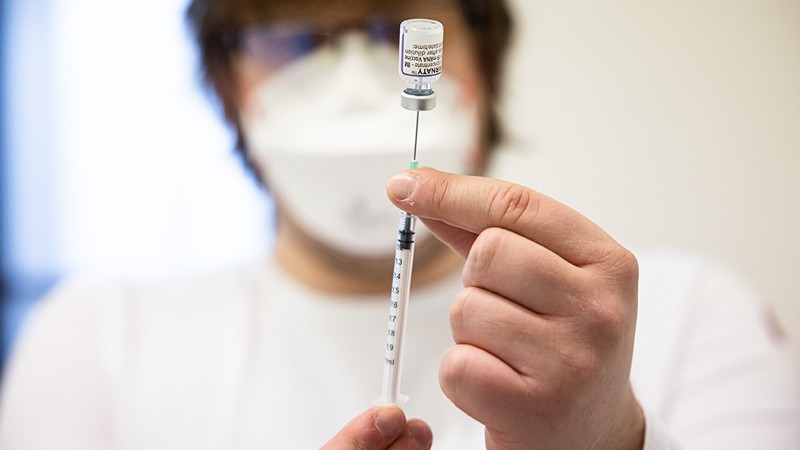
Project HEALINGS Article #1: What Are Vaccines?

Developed by Asian Media Access and Spitfire

Everyone has made changes in our lives because of COVID-19. Our daily routines are different, like working or learning from home, wearing masks, or staying six feet away from our friends and relatives.

One of the tools for keeping our communities safe from COVID-19 is the vaccine. Vaccines are like a seatbelt for our immune system. The immune system is the body’s defense system to fight off sickness and keep us healthy. Just like we wear seatbelts to stay safe in case of a car crash, getting vaccinated helps keep us healthy when viruses like COVID-19 spread.

Vaccines work by training our body’s immune system to fight sickness. If we do catch the virus, our bodies can react faster. That protects us from getting very sick or needing to go to the hospital.

When our body knows how to fight a virus, that is called immunity. Vaccines give lots of people immunity, which means the virus cannot spread as easily through the population. When viruses spread, they can change into new forms. Vaccines help stop viruses from changing into new forms that cause more harm.

Vaccines have helped communities fight viruses for more than 100 years. Vaccines fought off smallpox, measles, and polio and are the main reason these deadly viruses are not common today.  Building off of the experience with smallpox and other viruses, scientists developed safe and effective vaccines for COVID-19. The technology and ingredients used in the COVID-19 vaccines were researched for decades.

Three companies (Pfizer, Moderna, and Johnson & Johnson) developed COVID-19 vaccines that are safe and effective. The vaccine ingredients are similar to food ingredients. They are made up of mNRA, fats, sugars, and salts. Like food, the vaccine ingredients leave your body after they have done their job.

mRNA is the ingredient that makes the Pfizer and Moderna vaccines work. mRNA is a molecule that gives the immune system instructions about how to fight the virus. These harmless molecules allow our immune systems to practice fighting COVID-19 and build a strong defense.

 Pfizer-BioNTechModernaJohnson & Johnson
Active ingredient:mRNAmRNAVector (deactivated piece of virus that helps the immune system build a defense)
For ages:5+18+18+
Doses:2 + boosters2 + booster1 + booster
Effectiveness:95%95%67%

Each of the vaccines went through three strict periods of research and testing to make sure they are safe and effective. Each vaccine also received two approvals. One was from the Food and Drug Administration (FDA), the government agency in charge of making sure medicines are safe. The other was from the Advisory Committee on Immunization Practices. These are medical and health experts who develop guidelines for safely using vaccines.

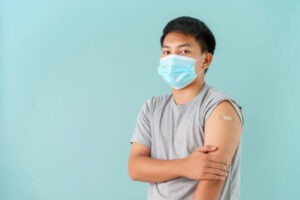
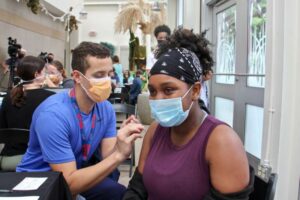
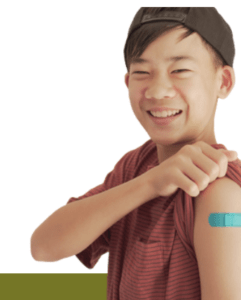
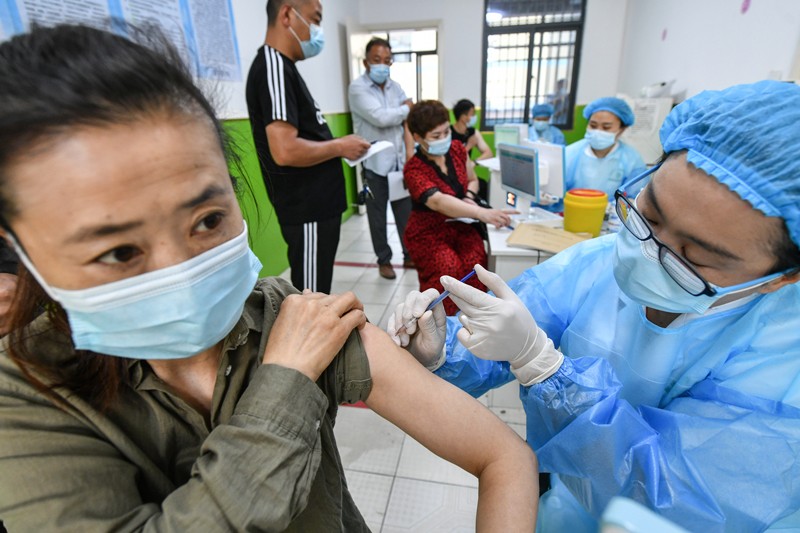
Since the vaccines were approved in December 2020, 255+ million people in the United States have taken them. That is why it is now safer to return to school and work. It is also safer to see our loved ones in person.  Getting vaccinated is free and easy. Local clinics, pharmacies, and healthcare centers in your community provide vaccines at no cost. You do not need health insurance or an ID to get one.

After getting the shot, it is normal to feel a little sick. You might have soreness in your arm, headaches, tiredness, muscle pain, chills, fever, or nausea. These are signs the vaccine is working. Your body is learning how to fight the virus.

COVID-19 is especially dangerous for older people and people with other health problems. Their bodies cannot fight off viruses very well. Vaccinations can help these people stay safe from the virus. If you have someone in your family who is older or has a health problem, getting vaccinated protects their health and your own.

COVID-19 has made the last two years scary and overwhelming. But you can take control of your health and protect your community by learning more about the vaccine. Doctors and nurses are ready to answer your questions and ease your worries. So, keep asking questions and talking with family members and friends about their vaccine experience. That will help you decide whether vaccines are right for you and your community. For more information, visit projecthealings.info.

English Version Chinese Version French Version Hindi Version Hmong Version Khmer Version Oromo Version Somali Version Spanish Version Swahili Version Thai Version Vietnamese Version

Cultural Medicine

When it comes to cultural medicine, we have to mention chinese medicine and western medicine. This article will analyze these two culture that the differences. The following points are some of my personal views.

Traditional Chinese medicine has been practiced in China for thousands of years. traditional Chinese medicine, is a label that covers a broad range of traditional medicine practices spread throughout Asia, including various forms of herbal medicine, acupuncture, massage therapy, and dietary therapy. In the past decade, there have been intensive debates in China about the nature of this ancient practice and its future development. Some critics argue that Traditional Chinese medicine theories are inaccurate descriptions of the human body that verge on imagination, and so have no place in modern healthcare systems. Other, however, say that Traditional Chinese medicine has a lot to offer to Western science and medicine and that emerging analytical tools hold great potentials in bridging the gap between the two worlds with contrasting philosophy and approaches.

Western medicine is the term used to describe the treatment of medical conditions with medications, by doctors, nurses and other conventional healthcare providers who employ methods developed according to Western medical and scientific traditions. Other names for Western medicine include traditional medicine or allopathic medicine. It differs from Eastern, or alternative, medicine, in its approach to treatment, which relies heavily upon industrially produced medications and a strict adherence to the formal scientific process.

A Chinese medicine doctor treats illness by the way of generalization, emphasis entirety and dialectical treatment, so some people view it as holistic medicine. A western medicine doctor treats illness by the symptoms. For instance, if you have a sore throat, the western medicine doctor consider it as a throat problem, while a Chinese medicine doctor may link it to your stomach trouble.An objective comparison of Eastern and Western approaches to medicine is necessary to further evaluate the validity of Oriental medical techniques such as acupuncture. The development of medicine in Western nations follows the way of hypothetical deduction and the Eastern approach uses the inductive method. The Western approach clearly divides the health from the disease, yet the Eastern approach considers health as a balanced state versus disease as an unbalanced state. The Western approach tends to change the environment and the Eastern way is to prefer to adapt to the environment. There are numerous difficulties in comparing these two approaches. The same terminology may apply to entirely different facts, the teaching and learning methods are quite different, and the evaluation of the treatment is almost not comparable.

Cultural Stories

To Borrow Arrows with Thatche ‘d Boats

This is an episode from the Three Kingdoms. Zhou Yu ordered Zhuge Liang to manufacture 100,000 arrows within ten days. Zhuge said,“Give me three days.” He also signed a pledge placing himself liable for punishment should he fail to complete the order. Zhou Yu ridiculed that Zhuge Liang was looking for self-destruction.On the one hand, Zhou Yu ordered his troops not to provide Zhuge Liang with materials to make the arrows.He also sent Lu Su to spy on him to find out what was going on. In fact, Zhuge Liang had already realized that this was a plots room, Zhuge said to Lu Su,“Save me please.” He asked Lu Su to lend him 20 boats, each lined with straw-made scarecrows and manned by 30 soldiers. He requested that Lu Su not tell Zhou Yu what was happening.

When Lu Su came again to see Zhuge Liang he did not find anything unusual. Nothing happened on the second day either. In the small hours of the third day that Zhuge Liang invited Lu Su for a boat ride. The 20 boats were tied together with strong ropes. Zhuge’s fleet sailed toward the camp of Cao Cao. A thick mist had spread over the surface of the river. People could hardly see each other on the river. When Zhuge’s fleet got close to the Cao Cao camp before dawn, Zhuge Liang ordered his soldiers to shout and beat drums to fake an attack. Zhuge and Lu Su simply sat inside one of the boats and drank wine to enjoy themselves. As soon as the Cao Cao camp heard the shouting and drum beating, they mistook it for a surprise attack by the Zhou Yu camp. Since they could see nobody on the river, they gathered 3,000 bow men and ordered them to shoot arrows towards where the shouting and drum beating came. The front of the scarecrows was quickly shot full of arrows. After a while, Zhuge Liang had his fleet turned around to expose the other side of the scarecrows. When this side was also shot full of arrows when the day broke. Zhuge Liang ordered his soldiers to retire. Zhuge Liang got the 100,000 arrows and solved the shortage of military supplies.

Feelings on Coming to the United States

The first day I came to the United States, my biggest feeling is that Americans are very enthusiastic and friendly. At the airport, everyone took the initiative to help us, seeing that we were holding the fast track sign and letting us move forward. It was very late when I arrived in the Minneapolis / Saint Paul airport. The host family took the sign to pick me up. They asked me if I was tired and hungry, and I felt very enthusiastic. When we arrived at the host family’s house, they introduced me to the layout of the home, which was great. The next day, the host family took me to their church and introduced me to many of their friends. Those who I was not introduced to would greet me on their own initiative.

   Although I have only been here for a few days, I can also feel some differences between the United States and China.

   First, in terms of religious beliefs. Most Americans believe in religion and believe in God. According to Christian beliefs, every person is the son of God. Christianity pays attention to fraternity, and this value is also reflected in the relationship between people. Christianity emphasizes that human happiness stems from the grace of God. However, only a minority in China believes in Christianity.

    Second, in terms of friendship. The education of Chinese people is usually to avoid direct conflicts, open criticism, and controversial topics.They want to maintain harmony among people around them and leave ”faces” for others; on the contrary, Americans are usually willing to face problems directly, criticize, discuss controversial issues, and insist on what they consider to be ”facts”.

  Third, in the terms of living habits.  Lifestyle choices between the United States and China are also different. For example, Americans like to use forks and knives when eating, Chinese people generally use chopsticks; Americans like to eat burgers, Chinese people like to eat dumplings, Americans usually like to bathe in the morning, Chinese people prefer to take a shower at night, etc.

    Although there are many cultural differences between the United States and China, there are still many things that I need to learn. There are many places that China needs to learn from. We learn from each other and believe that we will do better in the future.

Feelings on Bicultural Healthy Living

Nowadays, Bicultural Healthy Living is more and more popular all over the world. As a Chinese volunteer, I feel honored to experience the two cultures of the United States and China, which are quite different from each other.

As far as diet is concerned, most Chinese food is fried and boiled, while after spending time with native people in the United States, I found the food is mostly roasted. American people eat fresh vegetable salad to add vitamins but Chinese people prefer scrambled eggs with tomatoes or fried cabbage.They like butter or cheese but Chinese people like salt or sauce to make food delicious. I think we should use a small amount of salt or cheese to supplement the protein needed for one day. In addition, Chinese people usually drink hot water not cold water to promote metabolism in the body. People go to the restaurant to eat, where warm water is generally available.

When it comes to living habit, different people hold different attitudes. From my point of view, in China, people use slippers at home and don’t like to walk barefoot on the marble floor at home otherwise they will feel the cold into the body and think it is uncomfortable. But in the United States, people like to walk barefoot on the wooden floor at home. In order to keep biculturally healthy, I would recommend that keep your feet warm in winter and comfortable in summer.

In America, I think most people regard cars as main transportation.They just drive their cars to go sightseeing or order food at McDonald’s. However, in China, especially in Beijing, because of the large population, some vehicles are restricted to travel to control traffic jam, which depends on number plates. A lot of people walk to and take the subway or go to a bus stop. Sometimes buses and subways are more convenient. In my opinion, bicycles are also great ways to get around and keep fit. If the destination is far away, we can choose to drive, if the road is closer, riding a bicycle is better.


Bicultural Healthy Living

Bicultural healthy living is increasingly recognized by all. Many students in China choose to study abroad or volunteer, which more and more people begin to accept cultural diversity.

Communication is an important mean of expressing yourself because it exists different ways of expression and so different kind of communication depending on the culture you belong to.

Bicultural and diversified is essential if we want to know more about culture. That is why cross-cultural communication is an essential exercise to do. A person who come from a certain country does not a certain country does not necessarily get the same ideas about dietary habit, time, identity.

I have an opportunity to volunteer in the United States so that I cherish this opportunity of cultural exchange very much. There is no doubt that this experience will be unforgettable.

My host family is in Saint Paul. I live with two Chinese friends called Grace and Leslie. The hostess of host family is Gayle. She is a French teacher at the university of Minnesota. Objects of Chinese and American food from eating the contents, Chinese people eat vegetables every day, much more than Americans, although Americans eat a lot of protein everyday.

However, there are two sides to everything. To illustrate, I’m not used to the food here, which they like to eat some healthy food such as mushroom and pumpkins. To a great extent, it was a difficult process for me to adapt to this diet. I, however, think is a very good opportunity to experience life in America, so I firmly believe that it’s not a great challenge for me.

I know that there are great cultural differences between the American and China, I know that there will be many challenges such as communication in the next four weeks. But, I am greatly convinced that I will be able to adapt to the language environment here.

Nourishing Loyalty—Qì of the Yang Earth Dog Wù Xū 戊 戌—Year 2018/4716

Happy Lunar New Year, below is an article from Tiger’s Play Astrology to illustrate the upcoming Year of Dog would be a year of fairness and equality!!!!

Check out the Asian Smokers’ Quitline during Lunar New Year Celebration

Prepare to Celebrate the Year of the Dog

The first day of Lunar New Year is on Feb 16, 2018 and it’s fast approaching! ASQ would like to wish everyone will have a fresh start in the year of the dog!

Getting ready for the new year

Some of the Asian community members may be busy with getting ready for the Lunar New Year and thinking about a resolution for the year of the dog, ASQ has prepared a pack of lucky red envelopes which will be given to each caller who calls ASQ to inquire quit smoking materials or to complete an online enrollment to receive quit smoking service. Red symbolizes good fortune in Chinese and Vietnamese cultures, that is why red envelopes are widely used during Lunar New Year and other celebratory events.

To celebrate the year of the dog and to wish everyone will have a healthy start of the New Year, these red envelopes are given out to Chinese and Vietnamese callers from now till Feb 20. While supplies last!

Help Smokers Quit

You can assist community members or patients to make a quit attempt by making direct referrals via ASQ web-based referral website or assist them to fill out an online enrollment form by going to one of the in language forms below:

简体中文
繁體中文

한국어

Tiếng Việt

Safe Routes to School plans Winter Walk to School Day Feb. 7

Safe Routes to School plans Winter Walk to School Day Feb. 7

Students are invited to join the Minnesota Safe Routes to School’s second annual Winter Walk to School Day Feb. 7.

“We celebrate winter in Minnesota. The cold, snow and ice are just another season and meant to be enjoyed,” said Dave Cowan, SRTS coordinator. “Walking and biking to school in winter is another way to get outside, be active and connect with your community. We encourage all Minnesota kids to put on their hats, gloves, boots and coats, and walk with a friend, class or entire school.”

Schools are invited to submit their stories and photos of their event to compete for the Golden Snow Boot Award. Last year, Pilot Knob STEM Magnet School won the award. The school dropped nearly 100 percent of their students at a community center about a mile away from the school.

“They traveled through parks and trails and noted that, in spite of the cold, they enjoyed watching the sunrise and felt it was a great community-building event,” said Cowan.

Join the Walk to School Day at Feb 7th, 2018.

Students at Elton Hills elementary walking in front of school on a snowy day